Chapter 23
When Oil Went Negative
When oil went negative: April 20, 2020, WTI at minus $37.63, Cushing storage limits, and what it revealed about physical futures.
The Unthinkable Happens
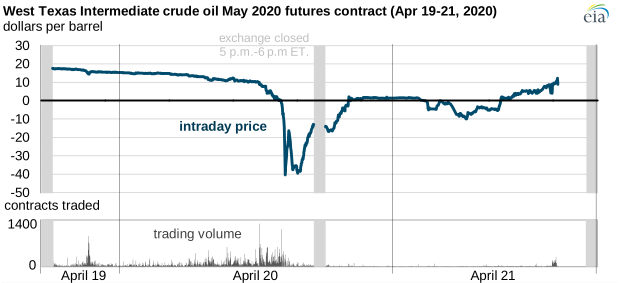
On Monday, April 20, 2020, the May 2020 WTI crude oil futures contract settled at negative $37.63 per barrel. Sellers paid buyers thirty-seven dollars for each barrel they would take away. It was the first time in the 37-year history of crude futures that the benchmark North American contract printed a negative number, and the intraday low touched roughly negative $40.32 before the settlement window closed. Oil, the most traded physical commodity on Earth, had briefly become a liability rather than an asset.
The event was not a glitch. Every trade that afternoon cleared. Every long who held past the close owed real money and every short who held through expiry collected it. The negative print was the correct output of a market where the physical delivery mechanism ran head first into a wall of full storage tanks, and a handful of financial holders who could not, and in some cases legally could not, take delivery of crude at Cushing, Oklahoma. To understand how finance was forced to pay physics, four pieces have to fit together: the WTI delivery mechanism, the Cushing storage picture, the COVID demand shock, and a small rulebook change at the clearing house made two weeks earlier.
Figure 23-1: WTI Front Month Daily Settlement, April 13 to 22, 2020
The WTI Delivery Mechanism
The WTI crude oil futures contract, traded under the symbol CL, specifies physical delivery of 1,000 barrels of West Texas Intermediate crude oil into Cushing, Oklahoma during the delivery month. The last trading day for a given contract month is the third business day before the 25th of the month preceding delivery. For the May 2020 contract, that was Tuesday April 21, 2020. Monday April 20 was therefore the penultimate trading day, the final full session before the contract rolled off the board.
Nearly all WTI volume is financial. Hedge funds, commodity index products, and retail ETFs have no trucks, no tanks, and no pipeline nominations at Cushing. In a normal month, roughly 99 percent of open interest is closed out or rolled forward well before first notice day. Traders sell the expiring contract and buy the next month, capturing or paying the calendar spread. A long who carries a position into final settlement is legally obligated to take delivery: nominate a receiving facility, arrange a ratable thirty day pipeline schedule through Cushing, and wire the full notional to the seller. No facility, no schedule, no plan, and the only remaining option is to sell at whatever price the screen shows.
Cushing: The Pipeline Crossroads With a Ceiling
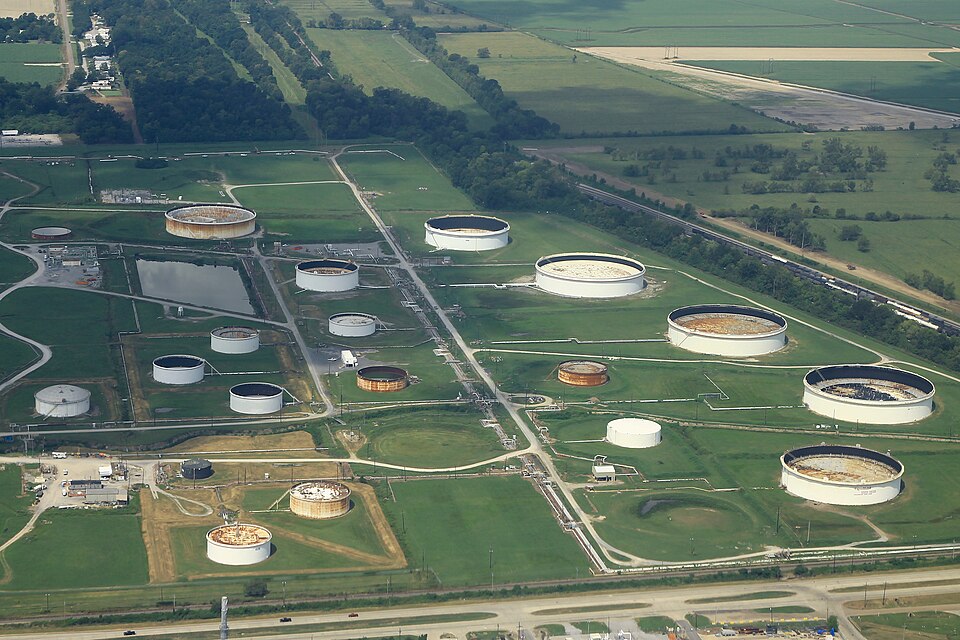
Cushing is a town of roughly 7,500 people in northern Oklahoma that sits at the intersection of more than 5,000 miles of crude oil pipeline. Inbound lines bring barrels from the Permian in West Texas, the Bakken in North Dakota, and Canadian heavy through the Keystone system. Outbound lines such as Seaway and Marketlink move crude south to the Gulf Coast refining complex. Between the pipes sits tank farm after tank farm of floating-roof storage. EIA tracks Cushing working storage capacity at roughly 76 million barrels, against a total shell capacity near 91 million barrels, where shell is the bare geometric volume and working capacity subtracts the minimum heels and rotation allowances that keep tanks operable. In practice, the operational ceiling is lower still, because tanks cannot all be filled at once without losing the ability to rotate barrels through the hub.
Through the first quarter of 2020, inventories at Cushing climbed from roughly 35 million barrels in January toward 60 million barrels by mid-April. The remaining working capacity was already under lease. A trader looking in mid-April 2020 for a spare tank to take May delivery would have been told there was none, at any price.
Figure 23-2: Cushing Storage Utilization, January to June 2020
Source: EIA Weekly Petroleum Status Report. Cushing working capacity approximately 76 million barrels. Illustrative weekly data.
The Pandemic Demand Shock
COVID-19 hit global oil demand with a speed and severity the industry had never seen. By April 2020, worldwide consumption had fallen by roughly 20 million barrels per day from pre-pandemic levels near 100 million bpd, with peak weeks estimated near 25 to 30 million bpd down. Governments locked down economies. Airlines grounded fleets. Road traffic evaporated. In the US, gasoline demand fell by about half in a matter of weeks. At the same time, the Saudi-Russia price war begun in March had flooded the market with supply. On March 6, 2020 OPEC+ failed to agree on new cuts, Saudi Arabia slashed its April official selling prices on March 8 and announced plans to lift output toward 12.3 million bpd, and Russia signaled it would match barrel for barrel. On April 12, 2020 the group reversed course with an emergency 9.7 million bpd cut, but the storage tide was already rising faster than the cut could drain it.
USO and the Crowded Front Month
Sitting at the center of the financial plumbing was the United States Oil Fund, ticker USO, an exchange-traded product sponsored by United States Commodity Funds LLC. USO is designed to track daily percentage changes in the price of WTI crude. It does this by holding WTI futures, rolling them forward each month according to a pre-published schedule. For most of its history USO was almost entirely invested in the front month contract, because that is where WTI volume and transparency are highest.
As retail investors tried to buy the dip in March and early April 2020, USO took in huge inflows. Assets under management climbed from roughly $1.5 billion at the start of the year toward $4 billion, and the fund became the largest single holder of the May 2020 WTI contract. The roll schedule was public and the position was disclosed through the weekly CFTC Commitments of Traders data, so every professional in the market knew where USO was and when it would have to sell. That is the definition of a front-running target. In mid-April, under regulatory pressure from both the SEC and the exchange, USO changed its methodology and began spreading exposure across second, third, and longer dated WTI. The fund filed a prospectus amendment and later settled with the CFTC and SEC in 2020 and 2021 over disclosure and investment policy issues, with investor class action litigation continuing into 2022.
A Small Rule Change at the Clearing House
On April 8, 2020 the exchange clearing house published an advisory notice warning members that its clearing and risk systems would be updated to accommodate negative prices in crude oil and related products, with test environments available starting the week of April 15. In plain English: until that change, the clearing infrastructure could not process a trade at a price below zero. Software systems at brokers, risk engines, option pricing models, and retail trading platforms all carried the same embedded assumption, that oil prices are non-negative, sometimes hard-coded in ways that took weeks to find and fix. Many of those downstream systems were not updated in time. On April 20, some retail platforms could not display the negative tape, some could not accept a sell order at a negative price, and some margined clients at zero when the true mark was far below.
TAS and the Afternoon of April 20
The WTI settlement price each day is a volume-weighted average of trades during a two minute window at the close. A mechanism called Trade at Settlement, or TAS, lets market participants agree during the day to transact at whatever the eventual settlement turns out to be, plus or minus a small offset in ticks. TAS is widely used by index funds, producers, and any trader who wants settlement exposure without standing in the closing auction.
On April 20, 2020, longs who had waited too long to roll discovered that the exit door was narrow. Prices opened in the mid teens and drifted lower through the morning. In the early afternoon, selling pressure overwhelmed the bids. As the contract cut through $10, then $5, then zero, algorithmic systems designed to cut losses on adverse moves amplified the decline. TAS orders placed earlier in the day were now locked to a settlement that was dropping by the minute. Retail products and managed funds that had to be out by the close had to sell into a bidless market. The final two minute window priced the accumulated imbalance: settlement landed at negative $37.63 per barrel, with the intraday low near negative $40.32. The June 2020 contract closed the same day above $20, producing a May-June spread wider than the entire historical range for WTI calendar spreads and effectively pricing one month of Cushing storage at an infinite value, since no incremental storage existed.
You did not even need to be in the oil business to lose money that week. Retail investors in exchange-traded products learned a painful lesson about the difference between financial exposure and physical commodity markets.
What the Physical Market Did That Day
Everything above is a futures story, and it needs separating from what physical crude was doing, because the two came apart on April 20 in a way that still confuses people reading the price records five years later.
Physical crude on the Gulf Coast was not in trouble. Cushing is a landlocked tank farm with a fixed number of pipelines in and out, which is what made it a trap. Houston is the opposite: refineries, export docks, and a coastline. Barrels that reached the water could be loaded and sold to anyone in the world. If you had wanted to find a genuine physical crisis on April 20, the Gulf Coast is the last place you would have looked.
And yet Argus assessed WTI Houston at roughly minus $25.48 a barrel that day. The number is real and the market was fine, and the reason both statements are true is a matter of arithmetic rather than economics.
Argus assesses WTI Houston as a differential, not as a flat price. The assessment reflects the volume-weighted average of physical trades at the Magellan East Houston terminal, expressed as a spread to the relevant NYMEX light sweet settlement, and the published outright is the two added together. On April 20 the relevant NYMEX settlement was the May contract, at minus $37.63. So back the differential out of the published number:
Platts did not publish a negative Houston number for the same day, which looks like a contradiction and is not one. The two agencies were assessing the same barrels against different reference legs on different roll conventions. When a flat price is derived rather than observed, the derivation does the talking on a day when the reference goes to minus $37.63, and two competent assessments of an identical market can sit twenty-five dollars apart without either being wrong.
That is the distinction to carry out of this chapter, because a minus sign in a price record can mean three different things. It can be a futures dislocation, which is what happened at Cushing and was entirely real. It can be a physical dislocation, meaning nobody will take the barrels at any price, which did not happen anywhere in the United States that week. Or it can be an artifact of how a price is constructed, which is what the Houston print was. Only the first two are market events, and telling them apart requires knowing how the number was built before reading anything into it.
The price reporting agencies drew the same conclusion, and quickly. Within weeks Platts opened a consultation on a new basis for pricing US crude, and by June 2020 had launched a waterborne Gulf Coast benchmark aimed explicitly at the flaws in a Cushing-based WTI; Argus developed its own Gulf Coast waterborne assessment on the same reasoning. The argument that a landlocked delivery point is the wrong anchor for a globally traded crude was made most forcefully by the events of a single afternoon, and it is the same argument that eventually put WTI Midland into the Dated Brent basket, covered in Chapter 17.
Aftermath, Lawsuits, and Reforms
The June 2020 contract did not print a negative number, but it came close. Cushing inventories peaked in early May at roughly 65 million barrels and then began to draw down as the OPEC+ 9.7 million bpd cut took effect and refiners ramped runs back up through the summer. By June 2020, WTI was trading above $35. By March 2021 it had crossed $60. The negative print was a single day event, but the legal and regulatory tail was long. Multiple class action suits were filed in 2020 and 2021 against USO and its sponsor alleging disclosure and investment policy failures. The SEC and CFTC opened investigations, and in 2020 USCF settled with the SEC over disclosure issues and separately resolved matters with the CFTC, agreeing to civil penalties and policy changes. USO permanently restructured to hold a weighted basket of WTI futures across multiple months rather than concentrate in the front, removing the most obvious roll-date target. The exchange, for its part, raised margin requirements on front month WTI and communicated explicitly in advance of subsequent expiries when negative prices remained a technical possibility.
Negative Prices Elsewhere: Power Markets
Negative prices are not unique to oil. In European day-ahead power markets, negative prints are now a routine feature of sunny, windy afternoons. According to Fraunhofer ISE Energy-Charts and ENTSO-E transparency data, Germany saw roughly 470 hours of negative day-ahead power prices in 2024, a record, driven by high solar and wind output coinciding with low demand. The Netherlands, Nordic countries, and Belgium all saw similar patterns. The mechanism is structurally the same as oil in April 2020: supply that must run, in the power case because of must-take renewables and inflexible baseload, meets a demand ceiling, and the clearing price falls through zero because the marginal producer pays to keep generating rather than curtail. The reader who understands the WTI storage picture already understands why power can trade negative on a sunny Sunday in April.
What differs is frequency, and frequency changes what the price means. Oil has settled below zero once. Power does it for hundreds of hours a year in several markets, and the count rises with every gigawatt of solar built. At that point a negative price stops being an accident of one expiry and becomes a standing feature of the market design, a signal telling somebody to stop producing or to start consuming. Power 101, the companion volume on electricity, works through why a power market has no floor at zero, what a must-run unit is, and who is being paid by whom when the price goes below it.
What Negative Prices Taught the Market
Negative oil prices were a once-in-a-generation event born from the collision of a pandemic, a price war, and the rigid mechanics of physical delivery. In commodity markets, the laws of physics trump the laws of finance. Storage is finite. Pipelines run on schedules. Tanks have heels. A barrel of oil that nobody can receive is not worth zero, it is worth less than zero, because the owner still has to put it somewhere. For producers and consumers managing real price risk, the lesson is that cash-settled hedges (fixed price swaps, Brent-referenced crack spreads, collars without physical delivery obligations) behave differently from a naive long in front-month WTI when storage runs out.
A single afternoon in April 2020 rewrote the textbook for physical commodity markets. The world learned that the price of oil can be negative, that the clearing house can rewrite its own rules on two weeks notice, and that a passive ETF can become the most important participant in the most important contract in the world.