Chapter 8
Standards
Petroleum product standards: API, ASTM, octane, cetane, flash point, pour point, and the specifications that define fuel quality.
Why Standards Matter
Without standardization of finished petroleum products, the modern world could not function. Standardized gasoline allows automobile engineers in Germany, Japan, and the US to independently design engines optimized for fuels available at any service station worldwide. Aircraft on long-haul flights can refuel with the same grade of jet fuel at airports on opposite sides of the planet. Ocean-going tankers can load bunker fuel in Singapore, Fujairah, or Rotterdam knowing the product will meet the same international sulfur spec.
Standards also underpin supply reliability: shortages in one region can be met with supplies from another. They push competition between refineries and distributors down to consumer prices. They let regulators set common environmental controls for each product. And they give traders, refiners, and importers a legal language for describing exactly what molecule is changing hands in a contract. This chapter is a reference. Each table below stands on its own.
Standards-Setting Organizations
A handful of organizations set the specifications and test methods that govern the global oil market. Most oil contracts reference ASTM test methods by number for crude and product specs. European contracts reference EN specifications. Marine fuel contracts reference ISO 8217. Emissions rules come from national and regional regulators: the US EPA, California's CARB, the European Commission, and the IMO for international shipping.
Table 8-1: Bodies that write the rules
| Body | Full name | Primary scope |
|---|---|---|
| API | American Petroleum Institute | Upstream standards, API gravity scale, industry data |
| ASTM | ASTM International (formerly American Society for Testing and Materials) | Most global crude and product test methods (D-series) |
| ISO | International Organization for Standardization | Marine fuels (ISO 8217), global cross-industry specs |
| CEN / EN | European Committee for Standardization | EN 228 gasoline, EN 590 diesel, EN 14214 biodiesel |
| EPA | US Environmental Protection Agency | US federal fuel sulfur, RFS ethanol mandate, emissions |
| CARB | California Air Resources Board | California gasoline and diesel specs, LCFS |
| IMO | International Maritime Organization | Marine fuel sulfur cap, MARPOL Annex VI, GHG rules |
Crude Oil Tests
A crude assay is a battery of standardized laboratory tests that describes the barrel in enough detail for a refiner to know whether it fits the plant. Chapter 2 (Crude Oil Assay) introduced the overall concept; the table below is the reference card for the individual tests. Every major contract references these method numbers.
Table 8-2: Core crude oil assay tests
| Property | ASTM method | Typical range | Refining implication |
|---|---|---|---|
| API gravity | D287 / D1298 / D4052 | 10 to 50 degrees API | Yield: light crudes make more gasoline, heavy make more resid |
| Sulfur content | D4294 (XRF) / D5453 | 0.05% to 4% by weight | Hydrotreating demand, catalyst poisoning, bunker compliance |
| TBP distillation | D2892 | Curve from IBP to 565 deg C | Maps the yield of every cut: naphtha, kero, diesel, VGO, resid |
| Pour point | D97 | -60 to +35 degrees F | Pipeline transportability in cold weather; waxy crude risk |
| Total acid number (TAN) | D664 | 0.05 to 4 mg KOH/g | Naphthenic acid corrosion in hot piping, CRU selection |
| Kinematic viscosity | D445 | Varies widely | Pumping, blending, pipeline hydraulics |
| Salt content | D3230 | <10 to >200 PTB | Desalter performance; corrosion in overhead systems |
| Vanadium, nickel | D5863 / ICP | 1 to 500 ppm | FCC catalyst deactivation, resid coke quality |
Octane: RON, MON, and AKI
Octane rating measures gasoline's resistance to knocking, the premature auto-ignition that occurs when fuel in a cylinder detonates ahead of the spark. Higher octane lets engine designers run higher compression and more aggressive spark timing, both of which raise thermal efficiency. The scale is defined by a two-point reference: iso-octane (2,2,4-trimethylpentane) is arbitrarily set to 100 and normal heptane to zero. A fuel with the same knock resistance as a mixture of 87% iso-octane and 13% n-heptane rates 87 octane.
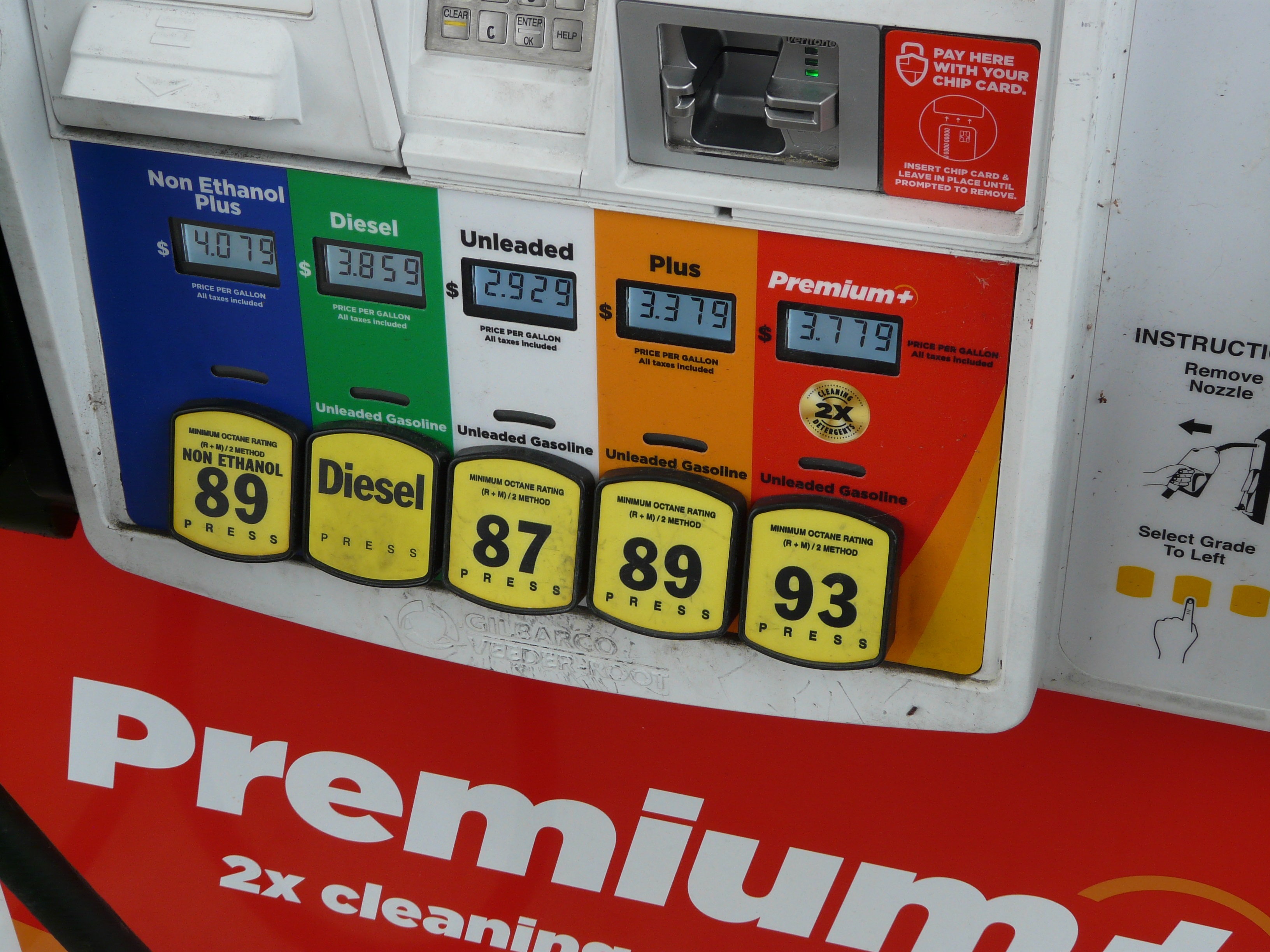
Two different test engines give two different numbers from the same fuel. Research Octane Number (RON, ASTM D2699) runs a low-severity test, simulating city driving at lower load. Motor Octane Number (MON, ASTM D2700) runs a hotter, higher-load test closer to highway conditions. MON is always lower than RON; the gap between them is called sensitivity. Europe posts RON on the pump. The US posts Anti-Knock Index, which is the average of the two.
AKI, the US pump number
AKI = (RON + MON) / 2. Regular unleaded in the US is 87 AKI. Midgrade is 89. Premium is 91 to 93. In Europe, the same fuels post as roughly 95 and 98 RON, which looks higher but is not. Iso-octane rates 100 on both scales by definition; n-heptane rates 0.
Gasoline Specifications
Modern gasoline is a carefully blended cocktail with its specification pinned down by federal and state rules. The biggest single change in the last decade was EPA Tier 3, which cut the annual average gasoline sulfur from 30 ppm to 10 ppm effective January 2017. That alignment with European and Japanese gasoline sulfur allowed car makers to certify a single catalyst formulation worldwide.
Table 8-3: US gasoline specifications (Tier 3 / federal)
| Property | Test method | Limit |
|---|---|---|
| AKI (regular / mid / premium) | D2699, D2700 | 87 / 89 / 91-93 |
| Sulfur (annual average) | D5453 | 10 ppm |
| Benzene (annual average) | D5580 | 0.62 vol% |
| Reid Vapor Pressure (summer) | D5191 | 7.8 psi (9.0 psi non-ozone areas) |
| Reid Vapor Pressure (California summer) | D5191 | 6.5 to 7.0 psi |
| Ethanol (E10 standard) | D4815 | 10 vol% typical, 15 vol% allowed |
| Lead | D3237 | Banned since 1996 (road use) |
Reformulated Gasoline (RFG) is a tighter federal spec required in ozone non-attainment areas, originally introduced by the Clean Air Act of 1990. California CARB Phase 3 gasoline (CaRFG3) is tighter still, with lower benzene, lower RVP, and lower olefin content. Chapter 9 (Finished Products) covers gasoline blendstocks.
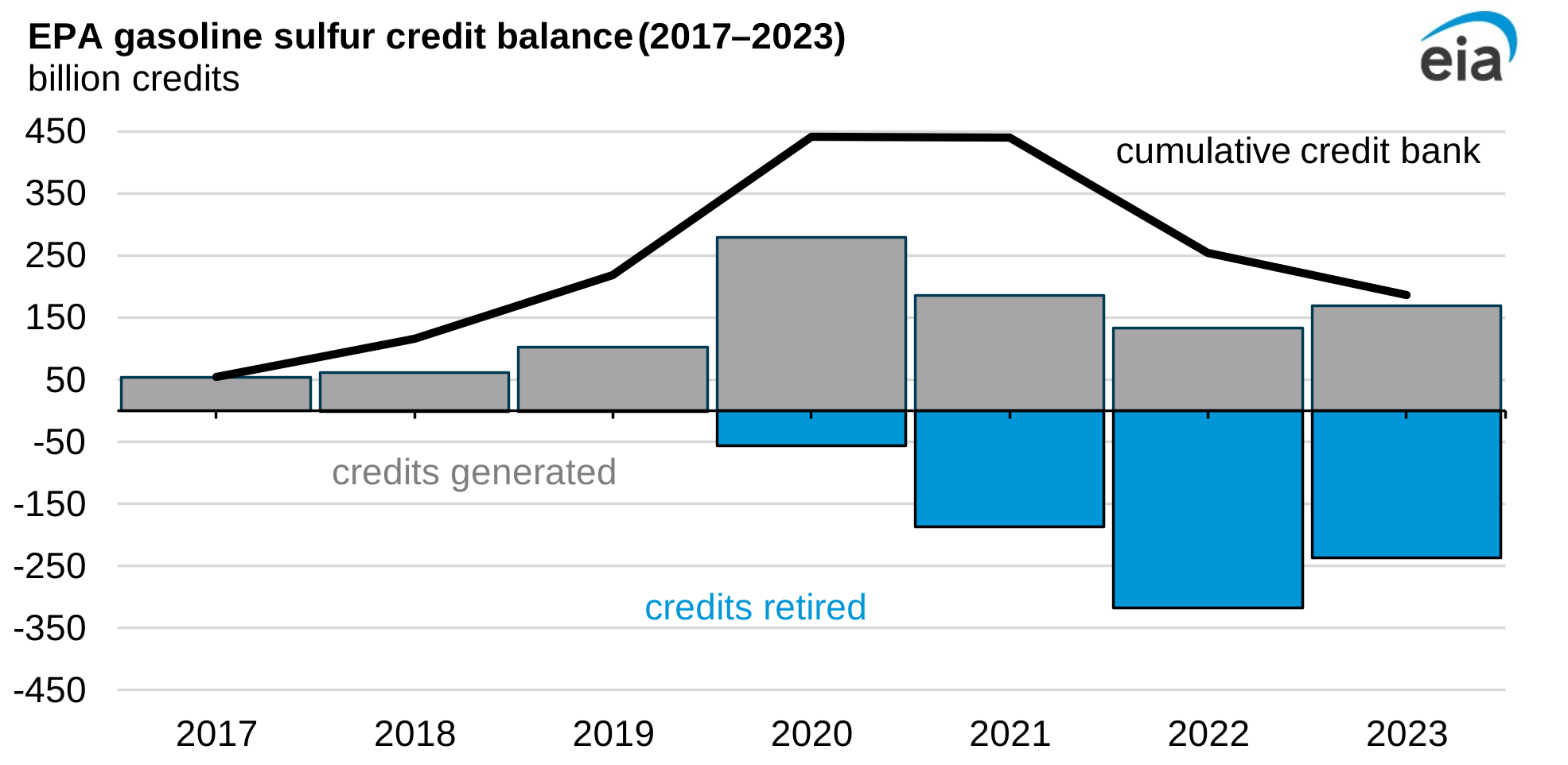
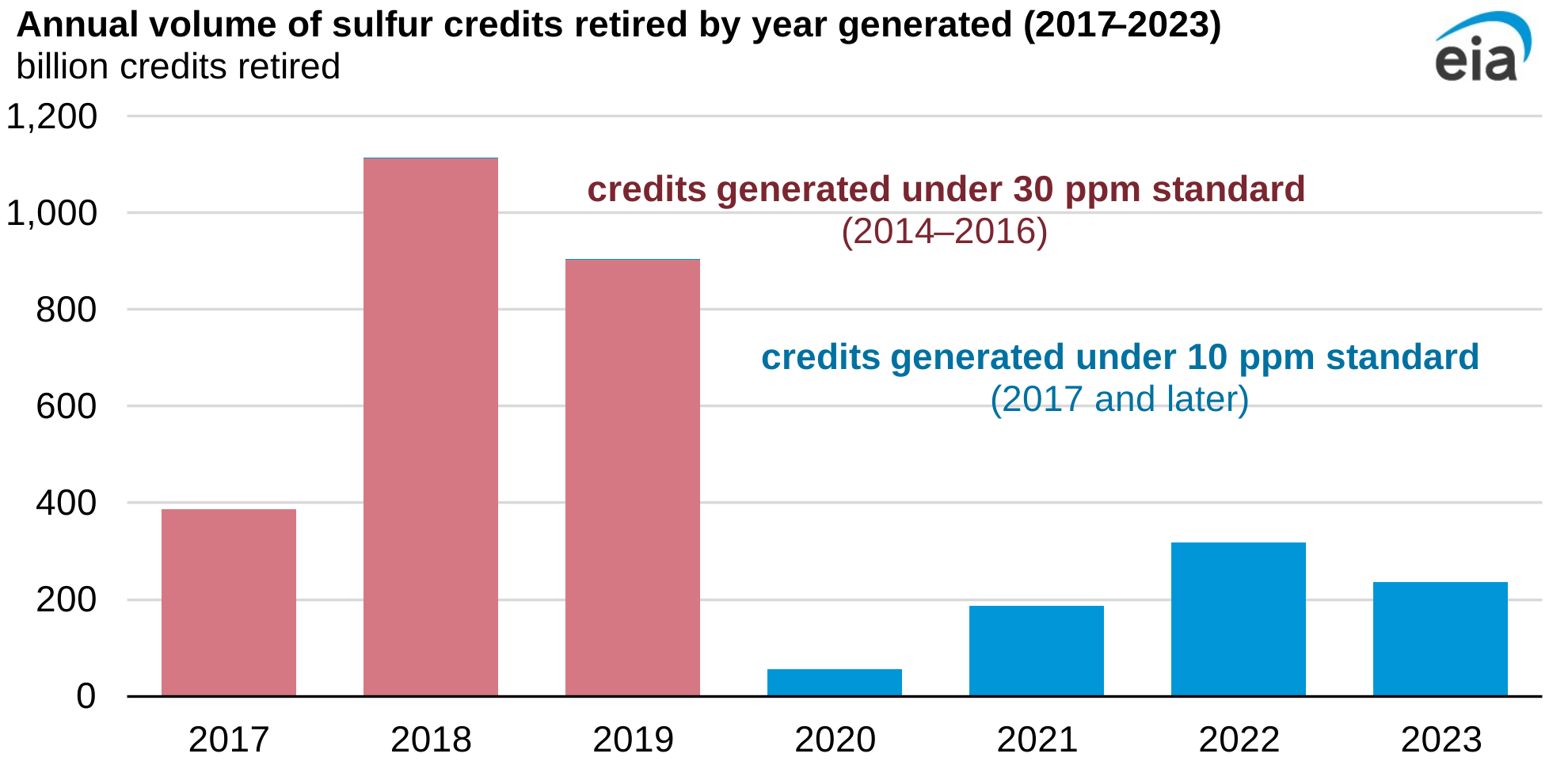
Figure 8-4: US Gasoline Sulfur Limits, 1990 to 2026 (ppm)
Source: EPA gasoline sulfur regulations (Tier 1 1995, Tier 2 2004, Tier 3 2017). 97% reduction over three decades.
Diesel Specifications
Diesel combustion is the mirror image of gasoline combustion. Gasoline needs to resist auto-ignition; diesel needs to auto-ignite promptly under compression. Cetane number is the diesel equivalent of octane, defined by a two-point reference of cetane (n-hexadecane, 100) and heptamethylnonane (15). Higher cetane means shorter ignition delay and smoother combustion. On-road ULSD sold in the US is typically in the 42 to 48 cetane range; European EN 590 diesel runs slightly higher at a 51 minimum.
Table 8-4: US on-road ULSD specifications
| Property | Test method | Limit |
|---|---|---|
| Cetane number (minimum) | D613 | 40 |
| Sulfur | D5453 | 15 ppm |
| Flash point (minimum) | D93 | 52 deg C |
| Cloud point | D2500 | Regional by climate |
| Lubricity (HFRR wear scar) | D6079 | 520 micron max |
| Aromatics (California) | D5186 | 10 vol% |
The ULSD transition has been the defining diesel regulatory story of the last generation. EPA sulfur limits moved from 500 ppm LSD in 1993 to 15 ppm ULSD in 2006 for on-road fuel, 2010 for non-road, 2014 for locomotive and marine. The cut was required to enable modern emissions control devices: diesel particulate filters (DPF) and selective catalytic reduction (SCR) catalysts are both poisoned by sulfur, so ULSD was a precondition for modern diesel passenger cars and for Tier 4 off-road engines.
Jet Fuel Specifications
Jet fuel is the most safety-critical and most internationally standardized petroleum product. ASTM D1655 defines Jet A and Jet A-1 for commercial aviation; Defence Standard 91-91 is the equivalent UK specification. Chapter 9 (Finished Products) covers the individual grades; the table here is the spec reference.
Table 8-5: Jet A and Jet A-1 specifications (ASTM D1655)
| Property | Jet A | Jet A-1 |
|---|---|---|
| Freeze point (max) | -40 deg C | -47 deg C |
| Flash point (min) | 38 deg C | 38 deg C |
| Sulfur (max) | 3000 ppm | 3000 ppm |
| Aromatics (max) | 25 vol% | 25 vol% |
| Smoke point (min) | 25 mm | 25 mm |
| Primary market | US domestic | International |
Residual and Bunker Fuel
The single most important regulatory event in the heavy end of the barrel in the last twenty years was the IMO 2020 sulfur cap. Effective January 1, 2020, the global marine fuel sulfur limit dropped from 3.5% to 0.5%, a seven-fold cut, for ships without scrubbers. Emission Control Areas (ECAs) around North America, the Baltic, and parts of Asia already required 0.1% sulfur fuel. The rule immediately split the bunker pool into three grades: HSFO (3.5% sulfur, for scrubber-equipped ships), VLSFO (0.5% sulfur, the new global standard), and MGO (0.1% sulfur, for ECAs). Chapter 9 (Finished Products) and Chapter 11 (Transporting Oil) cover the market consequences.
Table 8-6: Marine fuel grades after IMO 2020
| Grade | Sulfur limit | Where used |
|---|---|---|
| HSFO | 3.5% | Scrubber-equipped ships only |
| VLSFO | 0.5% | Global baseline for non-scrubbed ships |
| ULSFO | 0.1% | Sometimes used where ECA and open-sea switch is operationally painful |
| MGO | 0.1% | Emission Control Areas (North America, Baltic, North Sea, parts of Asia) |
Environmental rules keep tightening. Euro 7, China's National 6b, India's BS-VI, and the IMO's ongoing work on shipping greenhouse gases are all pushing refiners and vessel operators to invest in hydroprocessing, scrubbers, and alternative fuels. Chapter 9 (Finished Products) covers the resulting product slate.
The above was updated in 2026. For the full original 2009 chapter, download the 1st edition 2009 PDF.