Chapter 2
A Crude Oil Assay
Crude oil classification explained: API gravity, sulfur content, TAN, and the spectrum from light sweet to heavy sour grades.
What Is a Crude Oil Assay?
Crude oil is literally crude. To be useful, it must be processed in a refinery to separate out finished products: gasoline, diesel, jet fuel, heating oil, and residual fuel. Several hundred distinct grades of crude oil are produced worldwide, each with its own chemical fingerprint. Crude is not always black. It can be straw-colored, greenish, amber, or dark brown, and its viscosity can range from water-like to nearly solid.
The characteristics of an individual grade are documented in an analysis called an assay, prepared on behalf of the producer for sales purposes. An assay outlines the properties a refiner cares about most: expected yields of each finished product, density, sulfur content, acidity, viscosity, metals, salt, and water. Crude delivered outside its tight assay specifications is called “off spec” and can trigger expensive delays, forced re-routing to a refinery that can accept it, or steep discounts. A tanker carrying crude with no ready buyer is a “distressed cargo” and typically trades at a meaningful discount to the benchmark.

Fields, Streams, and Blends
Before discussing density and sulfur, it helps to understand where a barrel of crude actually comes from. A crude oil reservoir does not resemble an underground lake. Instead, oil is trapped between grains of sand or within tiny pores inside an otherwise solid rock matrix, like a rigid finely perforated sponge. An oilfield is an area containing a single reservoir or a group of reservoirs tied to the same geological structure, typically drained by a group of wells.
Production from a group of wells on one field is gathered and sent through a pipeline as a stream: raw wellhead crude with relatively stable properties that change only slowly over the life of the field. Streams from different pipelines are then combined to create a blend, the commercially traded marker. Blending serves two purposes: it pools enough volume to justify long-distance pipeline and tanker economics, and it smooths out extreme characteristics, such as very high sulfur or acidity, from any one stream. Brent Blend, for example, is named after the original Brent stream in the UK North Sea but today aggregates crude from several fields. Kirkuk Crude is named after the nearby Iraqi city. WTI is an aggregation of dozens of light-sweet streams gathered at Cushing, Oklahoma.
Table 2-1: Marker crudes: blends versus fields
| Marker | Type | Typical API | Typical sulfur |
|---|---|---|---|
| WTI | Blend of many US light-sweet streams, hubbed at Cushing | 40° | 0.24% |
| Brent | Blend of several North Sea streams (BFOET) | 38° | 0.37% |
| Dubai | Blend, Middle East sour benchmark | 31° | 2.0% |
| Maya | Mexican heavy-sour blend | 22° | 3.4% |
| Urals | Russian export blend (Volga-Urals plus Western Siberia) | 31° | 1.5% |
Most oilfields are modest: most produce under 100,000 barrels per day, and a long tail of marginal “stripper” wells yield ten barrels per day or less. Production is highly concentrated in a small number of very large fields. The IEA’s 2008 World Energy Outlook identified roughly 317 super-giant and giant fields supplying around 60% of global output, and subsequent IEA work still puts modern concentration in the same order of magnitude. The most famous is the Ghawar super-giant in Saudi Arabia, discovered in 1948, which at its peak produced close to 6 million bpd and remains the world’s largest producing field today by a hefty margin.
Table 2-2: Oilfield size hierarchy (recoverable reserves)
| Category | Recoverable reserves | Examples |
|---|---|---|
| Super-giant | above 5 bil bbl | Ghawar (Saudi Arabia), Burgan (Kuwait), Safaniya (Saudi Arabia) |
| Giant | 500 mil to 5 bil bbl | Prudhoe Bay (Alaska), Cantarell (Mexico), Daqing (China) |
| Large | 100 mil to 500 mil bbl | many North Sea, West African, Gulf of Mexico fields |
| Medium | 10 mil to 100 mil bbl | typical mature onshore development |
| Small | below 10 mil bbl | marginal and stripper wells, tens of thousands worldwide |
Density: The Most Important Property
Density is the single most important physical characteristic in an assay because it signals which hydrocarbon molecules are in the crude and therefore which products it will yield when refined. Heavy crudes are denser because they contain larger, longer hydrocarbon molecules with more carbon atoms. Lighter crude is generally more valuable: it readily yields a higher proportion of high-value products like gasoline, diesel, and jet fuel, and less residual fuel and bitumen.
Density also varies with temperature and pressure. A tanker loaded in a cold climate and discharged in a warm one weighs the same but occupies slightly more volume on arrival, which is why assayed densities are always quoted at a reference temperature.
Three measurements of density
The oil industry uses three interconvertible measurements of density, all typically quoted at 60 degrees F (roughly 15 degrees C) and 1 atmosphere:
- Metric density in kilograms per cubic meter (kg/m3). Water is 1000 kg/m3. This is the SI measurement and is used in most engineering and scientific work.
- Specific gravity(SG), also called relative density. The dimensionless ratio of the liquid’s density to the density of water at 60 degrees F. Water equals exactly 1.000. Anything lighter than water floats; anything heavier sinks.
- API gravity, an inverted index created by the American Petroleum Institute in 1921. The formula is deg API = (141.5 / SG) minus 131.5. Bigger number equals lighter crude.
All three measure the same physical property. API gravity became the industry standard because its inverted scale is convenient: a higher number corresponds to a lighter, more valuable crude, which matches traders’ and refiners’ intuition. Chapter 18 (Futures and Swaps) covers how API gravity enters quality differentials in futures contracts.
Table 2-3: API gravity, specific gravity, and metric density (60 deg F, 1 atm)
| API gravity (deg) | Specific gravity | Density (kg/m3) |
|---|---|---|
| 10 | 1.000 | 1000 |
| 15 | 0.966 | 966 |
| 20 | 0.934 | 934 |
| 25 | 0.904 | 904 |
| 30 | 0.876 | 876 |
| 35 | 0.850 | 850 |
| 40 | 0.825 | 825 |
| 45 | 0.802 | 802 |
| 50 | 0.780 | 780 |
| 60 | 0.739 | 739 |
Hydrometers and the Archimedes principle
Specific gravity and API gravity are read in the field with a simple instrument called a hydrometer, a weighted glass tube calibrated in density units. In a practical application of the Archimedes principle, the hydrometer sinks until the weight of fluid it displaces equals its own weight: it rides high in a dense liquid and low in a thin one. A thermometer is often built into the stem (a thermohydrometer) so readings can be corrected back to the 60 degrees F reference temperature. The concept predates modern crude markets. Antoine Baume introduced his eponymous scale in 1768, and the American Petroleum Institute standardized the modern API scale in 1921.
API density classification
Table 2-4: API density classification of crude oils
| Class | API gravity | Example | Refining implication |
|---|---|---|---|
| Light | >31° | WTI, Brent, Bonny Light | high gasoline, diesel, jet yield; any refinery can run it |
| Medium | 22-31° | Dubai, Arab Medium | balanced product slate; most global refineries configured for this |
| Heavy | 10-22° | Maya, Arab Heavy, Western Canadian Select | needs coker or hydrocracker to avoid large residual fuel yields |
| Extra-heavy | <10° | Venezuelan Orinoco bitumen | denser than water; requires diluent to move in a pipeline |
Figure 2-2: Global Crude Production by API Gravity Band
Illustrative distribution. Percentages are approximate shares of global crude and condensate production. Source: industry estimates, EI Statistical Review.
Crudes in the 30 to 39 degree API range are most commonly produced and in highest demand, because most refineries are configured to run them. WTI, traded on NYMEX, sits at 39.6 degrees API. Brent Blend is slightly heavier at around 38. Some crudes carry “light” in the marketing name even though they are technically medium: Saudi Arabia’s Arab Light, most of which comes from Ghawar, is about 34 degrees API.
Condensates above 50 degrees API are sometimes called the “champagne of crude oils” because they are so easily refined into high-value products like gasoline. They are often processed in specialized condensate splitters rather than in full refineries (see Chapter 7 (Refining)).
Sweet versus Sour: Sulfur Content
Sulfur is the second pillar of crude quality, and it lowers value in three ways. It displaces hydrocarbon molecules and reduces energy content per barrel. It corrodes metal piping, tanks, and refinery process units. And it becomes a regulated pollutant (sulfur dioxide, acid rain precursor) when burned, forcing refineries to install expensive hydrotreaters to strip it out before fuels can be sold.
Crude is classified by sulfur content by weight. The term “sour” references the distinctive rotten-egg smell of sulfur-laden crude, caused by hydrogen sulfide and mercaptans. At extremes, crudes tend to be either light-sweet or heavy-sour, because sulfur preferentially binds to larger, more complex hydrocarbon molecules. For the same reason, light products such as gasoline, diesel, and jet have lower intrinsic sulfur than heavy residual fuel and bitumen.
Table 2-5: Sulfur classification of crude oils
| Class | Sulfur (% by weight) | Example |
|---|---|---|
| Sweet | below 0.5% | WTI (0.24%), Brent (0.37%), Bonny Light |
| Medium-sour | 0.5% to 2.0% | Urals (1.5%), Oman Blend |
| Sour | above 2.0% | Dubai (2.0%), Arab Heavy (3.1%), Maya (3.4%) |
The Crude Quality Matrix
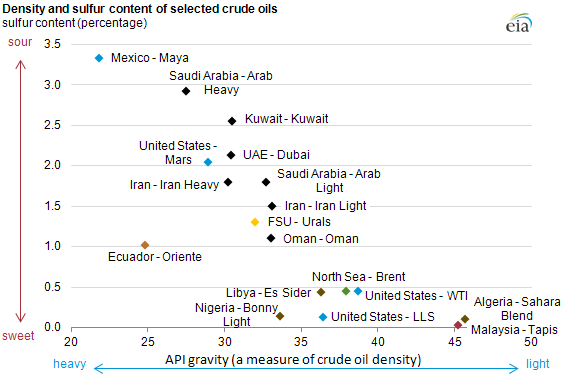
Plotting API gravity against sulfur gives the canonical two-dimensional map of crude quality. The most valuable corner is bottom-right: light and sweet, easy to refine into clean high-value products, deliverable into both WTI and Brent futures contracts. The least valuable corner is top-left: heavy and sour, requiring complex refineries with cokers and deep hydrotreating, and trading at persistent discounts to the light-sweet markers. Chapter 17 (Oil Prices) picks up how these quality differentials get priced.
The four quadrants each have recognizable residents:
- Light-sweet: WTI, Brent, Bonny Light, Saharan Blend. Premium pricing; any refinery can run them.
- Light-sour: Oman Blend, Arab Extra Light. High middle-distillate yield but needs hydrotreating.
- Heavy-sweet:rare; examples include Chad’s Doba and Angolan Dalia. Often carries high acidity to compensate, which offsets the low-sulfur advantage.
- Heavy-sour: Maya, Arab Heavy, Dubai, Western Canadian Select. The cheapest crude per barrel, but only complex refineries with coking and deep hydrotreating can profitably process it.
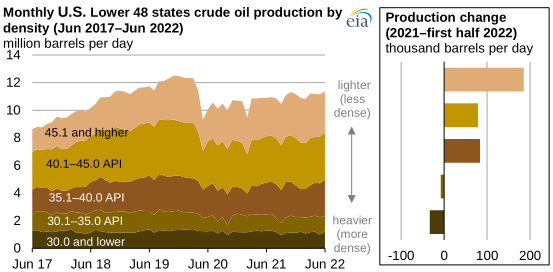
The proportion of sour crude in global production has been increasing as a larger share of new supply is heavy oil sands, Latin American heavy, and Middle East sour. The US refining fleet is the natural home for that barrel. Taken as a national system it is the most complex in the world, averaging a Nelson complexity index near 11.6 against roughly 9.8 in Asia and 9.3 in Europe. That is a claim about the average, not about any single plant. The largest and most complex individual refinery on earth is Reliance Industries’ Jamnagar complex in Gujarat, India, which can process about 1.24 million barrels per day, scores 21.1 on the same index, and is configured to run more than 200 different crude grades. Chapter 7 (Refining) covers the complexity index and the process units behind it.
Acidity, Metals, and the Rest of the Assay Sheet
Beyond density and sulfur, a full assay sheet lists a long tail of properties that matter to a refiner writing a purchase contract.
Total Acid Number (TAN), sometimes called the Neutralization Number, measures naphthenic acid content in milligrams of potassium hydroxide required to neutralize one gram of crude. Acids accumulate as bacteria in a reservoir biodegrade lighter hydrocarbons, which is why highly acidic crudes tend to also be heavy. Most refineries are set up to run crude with a TAN under 0.5. Anything above roughly 0.7 is flagged as highly acidic and carries a corrosion discount. Chad’s Doba blend, the Angolan Kuito and Hungo streams, and the North Sea Alba crude are well-known high-TAN grades. Doba has been assayed above 2.0.
Vanadium and nickel are metals that poison refinery catalysts, even in trace amounts, and concentrate in the heaviest fractions. Typical refinery intake limits are measured in tens to a few hundred parts per million combined. Heavy Venezuelan and Mexican crudes are particularly rich in vanadium.
Viscosity defines how easily a crude flows. Heavy crude is highly viscous because large hydrocarbon molecules tangle as they pass each other; it must often be heated or blended with a lighter diluent to move through a pipeline. Viscosity is measured in centistokes (cSt) at both 40 degrees C and 100 degrees C because it changes sharply with temperature. A 36 deg API crude might measure roughly 3.5 cSt at 40 deg C and 1.5 cSt at 100 deg C.
Pour point is the lowest temperature at which crude still behaves as a fluid and can be pumped. Below the pour point, waxy crudes gel and stop flowing, a serious hazard for tankers and pipelines in cold climates.
Reid Vapor Pressure (RVP), measured in psi, captures the volatility of the light ends. A higher RVP suggests more valuable light products in the barrel, but gasoline RVP is capped by environmental rules because evaporating fuel is a major smog precursor.
Carbon residue (Conradson Carbon Residue, Ramsbottom, or Microcarbon tests) indicates how much solid, coal-like coke the crude will throw off in a refinery coker. Values between 0.5 and 1.0 are typically acceptable. Asphaltenes, the heaviest aromatic molecules in the barrel and responsible for crude’s dark color, are correlated with carbon residue and can clog pipes and produce undesirable shot coke at high concentrations.
Nitrogen matters because nitrogen oxides are a regulated tailpipe pollutant and nitrogen compounds can also poison refinery catalysts. Salt must be removed in a desalter before crude enters the atmospheric column, or it will corrode downstream piping. And Basic Sediment and Water (BS&W)is a catch-all for the water, dirt, and junk that arrives with the crude. Less than 1% BS&W by weight is the usual refinery intake spec. Before dewatering at the wellhead, the raw water cut can be well over ten barrels of water per barrel of oil for a mature field.
Why the Assay Matters for Prices
Every property on an assay sheet eventually shows up as a price differential. WTI and Brent are light-sweet benchmarks; Dubai and Maya are heavy-sour benchmarks, and Chapter 17 (Oil Prices)covers how those differentials trade. The spread widens when global refining capacity is tight on coking and hydrotreating, and narrows when complex refineries have spare capacity chasing cheap heavy barrels. A refinery’s willingness to pay for any specific cargo is a yield calculation driven by the assay: expected barrels of gasoline, diesel, jet, and residual fuel at prevailing product prices, minus the cost of processing sulfur, metals, acids, and anything else the barrel carries. Assays are the first step to understanding why seemingly similar crudes can trade dollars per barrel apart.
The above was updated in 2026. For the full original 2009 chapter, download the 1st edition 2009 PDF.