Chapter 9
Finished Products
Petroleum products explained: gasoline, diesel, jet fuel, fuel oil, LPG, lubricants, asphalt, waxes, and their market dynamics.
The 19 Products of Crude Oil
A refinery does not sell "gasoline" or "diesel" the way a bakery sells bread. It sells a family of tightly specified commercial products, each defined by the boiling range it comes from, a handful of chemical tests, and the customer it serves. This chapter walks through those products in the order they come off the barrel, from the lightest gases at the top of the crude distillation tower to the solid petroleum coke at the bottom. Chapter 7 (Refining) covers the refinery units that make them and Chapter 8 (Standards) covers the specs that define them; this chapter is about the products themselves.
Table 9-1: The 19 products, lightest to heaviest
| # | Product | Typical boiling range | Primary use |
|---|---|---|---|
| 1 | Methane | Below -161°C (gas at room temperature) | Pipeline gas, petchem feed, refinery fuel |
| 2 | Ethane | Below -89°C (gas at room temperature) | Ethylene steam cracker feed |
| 3 | Propane | Below -42°C (gas at room temperature, liquefied under pressure as LPG) | LPG home heat, cooking, petchem, crop drying |
| 4 | Butanes | -1 to 0°C (gas at room temperature, easily liquefied) | LPG, winter gasoline blend, alkylation feed |
| 5 | Pentanes / natural gasoline | 30 to 70°C (light liquid) | Diluent, gasoline blend, petchem feed |
| 6 | Naphtha | 30 to 200°C | Reformer feed, petchem feed, gasoline blend |
| 7 | Gasoline | 30 to 210°C | Passenger vehicles, small engines |
| 8 | Jet fuel / kerosene | 150 to 275°C | Aviation, home heat in Japan |
| 9 | Diesel | 200 to 350°C | Trucks, rail, marine, power |
| 10 | Heating oil | 200 to 380°C | Residential heating, US Northeast and Europe |
| 11 | Atmospheric gas oil | 300 to 400°C | Marine in Emission Control Areas |
| 12 | Lubricant base oils | 350 to 500°C | Motor oil, industrial lubricants, process oils |
| 13 | Waxes | 350 to 500°C | Candles, food wrap, cosmetics, crayons |
| 14 | Vacuum gas oil | 400 to 550°C | FCC and hydrocracker feed |
| 15 | Fuel oil / residual | 450°C+ | Industrial boilers, power, ocean shipping |
| 16 | Bitumen / asphalt | 500°C+ (residuum) | Road paving, roofing shingles |
| 17 | Petroleum coke | Solid residue | Power fuel, aluminum anodes, steel electrodes |
| 18 | Carbon black | Manufactured from partial combustion | Tires, pigment, batteries |
| 19 | Sulfur | Byproduct of hydroprocessing | Sulfuric acid, fertilizer, rubber |
Figure 9-1: Petroleum Product Boiling Ranges (degrees C)
Source: Oil 101 (Morgan Downey), industry standard boiling ranges. Lighter products rise to the top of the distillation column; heavier products collect at the bottom.
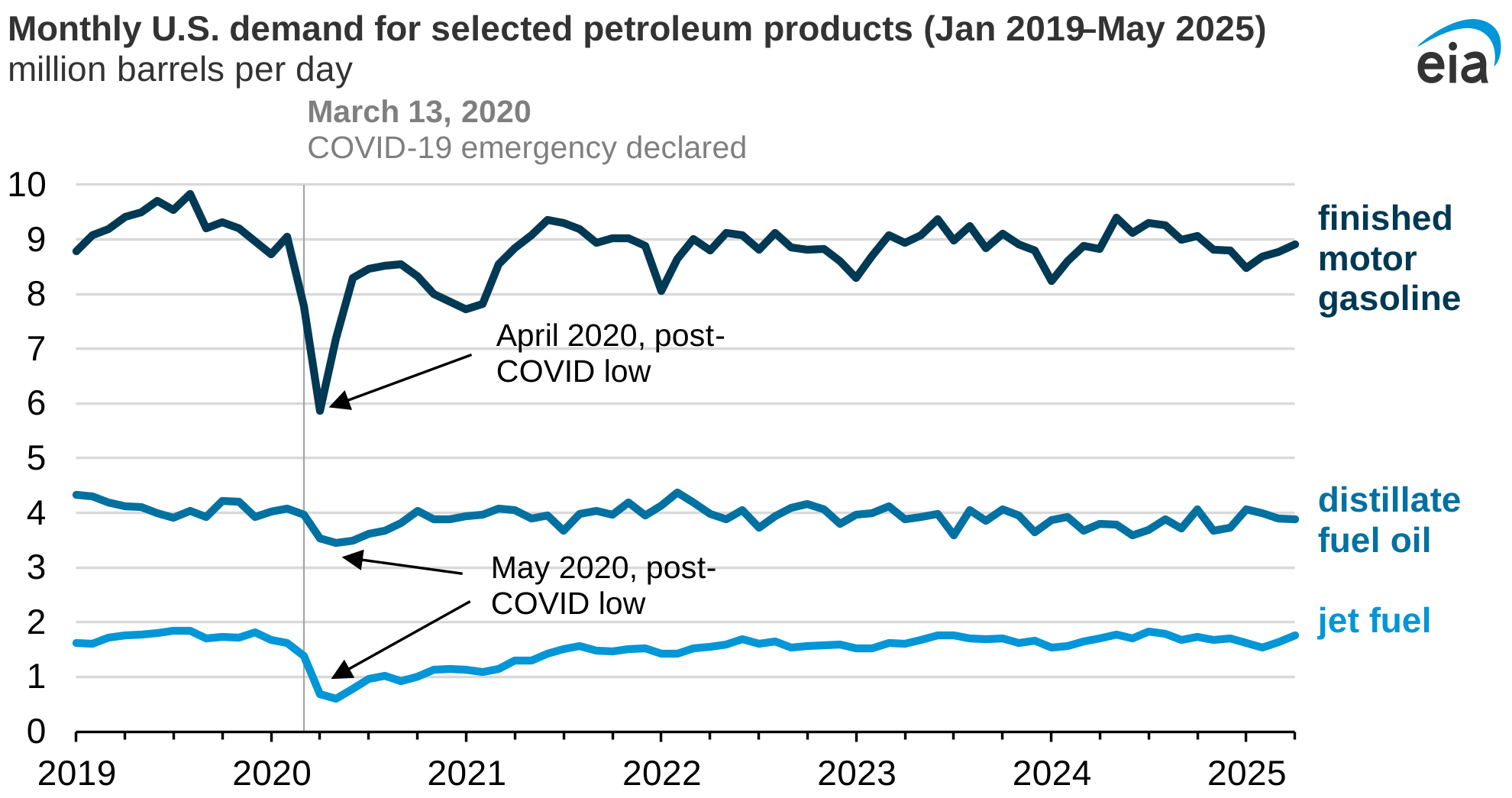
Table 9-2: US refined product demand (2024, approximate)
| Product | Demand (Mbpd) | Share of total |
|---|---|---|
| Gasoline | 8.9 | 44% |
| Distillate (diesel, heating oil, off-road) | 3.8 | 19% |
| LPG and NGL | 2.8 | 14% |
| Jet fuel | 1.7 | 8% |
| Other (residual, petchem feed, asphalt, etc.) | 3.0 | 15% |
| Total | 20.2 | 100% |
Figure 9-3: US Refined Product Demand by Product (2024)
Gasoline: A Cocktail, Not a Single Product
Motor gasoline is the most valuable high-volume product from a US refinery, accounting for about 45% of US refinery output by volume. What a refinery actually sells under the name "gasoline" is an assembly of six to eight separate blendstocks, each with its own octane, vapor pressure, sulfur, and aromatics profile. The blender's job is to hit the finished spec at the lowest total cost, adjusting the recipe daily as component prices shift. Ethanol is usually added at the distribution terminal rather than at the refinery so that the same base blend can serve both E10 markets and ethanol-free specialty markets.
Table 9-3: The principal US gasoline blendstocks
| Blendstock | Typical RON | Pool share | What it contributes |
|---|---|---|---|
| FCC gasoline | 91-93 | 35% | Volume workhorse; contains olefins and aromatics |
| Reformate | 98-102 | 30% | High-octane aromatic stream from catalytic reformer |
| Alkylate | 93-96 | 12% | Premium blendstock: clean, low sulfur, low RVP, iso-paraffinic |
| Isomerate | 82-88 | 5% | Light naphtha isomerized, clean, moderate octane |
| Hydrocracker gasoline | 80-87 | 5% | Moderate octane, very clean, low aromatics |
| Normal butane (winter only) | 93 | 3% | Cheap octane and RVP; restricted in summer |
| Natural gasoline (C5+) | 70-75 | 2% | Light NGL diluent from gas plants |
| Ethanol (terminal blend) | 109 (blend) | 10% (E10) | Oxygenate, octane booster, RFS compliance |
Ethanol deserves a special note. A 10% ethanol splash typically lifts finished gasoline octane by about two points and also bumps vapor pressure by about one psi, which is why the EPA grants a summer RVP waiver for E10 but not for E0. E15 is legal for 2001 and newer vehicles and gradually expanding. E85 flex fuel, a nominally 51% to 83% ethanol blend, remains a rounding error outside the Upper Midwest. Ethanol-free "rec fuel" is still sold at marinas and small-engine outlets where even trace ethanol is a problem.
The Summer-Winter RVP Switch
Reid Vapor Pressure (RVP) is the measure of how readily gasoline evaporates. Evaporated gasoline reacts with sunlight to form ground-level ozone (smog), so the EPA limits summer gasoline RVP more tightly than winter. The federal summer limit is 9.0 psi from May 1 (upstream of retail) and June 1 (at the pump) through September 15. In ozone non-attainment areas the cap drops to 7.8 psi; CARB specs are tighter still at 7.0 to 6.5 psi and start earlier. The EPA grants a 1.0 psi waiver for E10, meaning E10 gasoline may reach 10.0 psi in areas with a 9.0 psi limit, but no waiver applies in the strictest RVP zones.
In winter the RVP limit reverts to 11.5 psi or higher (some states allow up to 15.0 psi). Butane, with an RVP around 52 psi but a federal octane of 93, is the seasonal swing component. In winter, refiners splash cheap butane into the blend for both octane and volume. When summer limits kick in, butane has to come out, replaced by costlier low-RVP blendstocks such as alkylate and reformate. This is why the normal butane row in the blendstock table above shows "winter only."
The April-to-June transition creates what traders call the "orphan barrel" problem: late-winter gasoline sitting in terminals that does not meet summer RVP specs and cannot legally enter the summer distribution system after the switchover date. It either has to be blended down with very low-RVP stock or sold at a discount before the deadline. This creates a predictable seasonal premium for summer-grade gasoline starting as early as February, well before summer driving demand arrives. Chapter 13 (Seasonality) covers the demand-side pattern.
Gasoline Grades and the Ethanol Mandate
Gasoline grades are defined by Anti-Knock Index: regular is 87 AKI, midgrade is 89 AKI, premium is 91 to 93 AKI. Chapter 8 (Standards) covers the RON, MON, and AKI definitions. Premium exists to satisfy the higher-compression, turbocharged, direct-injection engines that dominate modern passenger car design. In the US, most of the country posts 93 as the top grade; California caps premium at 91. Reformulated Gasoline (RFG) is a federal spec required in ozone non-attainment areas, with lower RVP, lower benzene, and lower aromatics than Conventional Gasoline (CG). CARB Phase 3 gasoline is the strictest US spec, imposing tight limits on sulfur, aromatics, benzene, olefins, and T50 and T90 distillation points. Outside Tier 3 and CARB, US states still run a patchwork of "boutique fuels" that complicates pipeline scheduling during the summer switchover.
The federal Renewable Fuel Standard (RFS), enacted in 2005 and expanded in 2007, mandates blending renewable fuels into the US gasoline and diesel pool. Compliance is tracked through Renewable Identification Numbers (RINs), a credit attached to each gallon of qualifying renewable fuel. Refiners who blend enough ethanol generate RINs; those who do not must buy them on the open market from those who do. RIN prices fluctuate with ethanol economics and EPA volume mandates, adding a layer of financial complexity on top of the physical blending.
E10 is now ubiquitous at US retail pumps and represents effectively all regular gasoline sold. E15 (15% ethanol) was approved for 2001 and newer vehicles and, since a 2022 EPA emergency waiver made permanent by subsequent rulemaking, is allowed year-round. Adoption has been slow: infrastructure (underground tanks, dispensers, vapor recovery) and consumer wariness limit stations offering it. E85 flex fuel exists but represents a rounding error outside the Upper Midwest.
The "blend wall" is the structural limit. US gasoline demand is roughly 9 Mbpd; 10% ethanol means about 900,000 bpd of ethanol demand. Pushing above 10% on a national scale would require widespread station upgrades, expanded vehicle warranties, and pipeline modifications that are not yet in place. The blend wall has been the binding constraint on RFS compliance since roughly 2013.
Jet Fuel and the Arrival of SAF
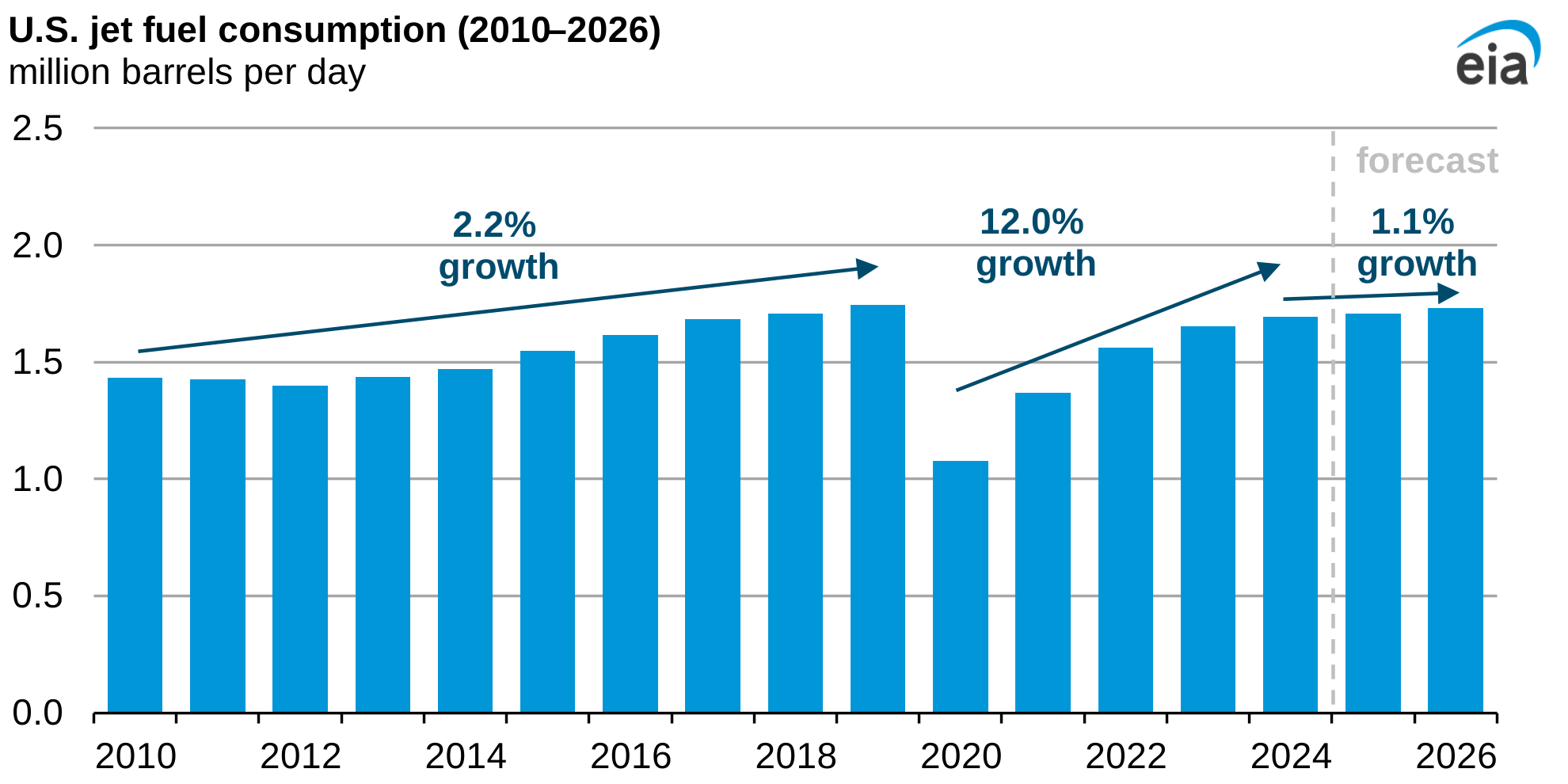
Jet fuel is chemically a narrow-cut kerosene, usually hydrotreated to remove sulfur and mercaptans and dosed with a small package of anti-static, anti-icing, and corrosion-inhibitor additives. Because a failure in flight is catastrophic, jet fuel is the most safety-driven and most internationally harmonized liquid fuel in the world. The grades below cover almost all global consumption. ASTM D1655 is the governing commercial spec.
Table 9-4: Jet fuel grades
| Grade | Freeze point | Flash point | Primary use |
|---|---|---|---|
| Jet A | -40 deg C | 38 deg C | US commercial aviation |
| Jet A-1 | -47 deg C | 38 deg C | International commercial aviation |
| Jet B | -50 deg C | -20 deg C | Wide-cut naphtha-kerosene, Canadian Arctic |
| JP-5 | -46 deg C | 60 deg C | US Navy carrier aircraft (high flash for ship safety) |
| JP-8 | -47 deg C | 38 deg C | US military land and air, kerosene with additives |
| Avgas 100LL | -58 deg C | -38 deg C | Piston general aviation; the last leaded fuel in common use |
Sustainable Aviation Fuel (SAF) is a post-first-edition development that has moved from curiosity to policy mandate in the last five years. The term covers any drop-in kerosene blendstock made from a non-petroleum feedstock. The commercialized routes are HEFA (hydroprocessed esters and fatty acids, made from used cooking oil, tallow, and vegetable oil), ATJ (alcohol-to-jet, made by dehydrating ethanol or iso-butanol and oligomerizing the resulting olefins), Fischer-Tropsch from biomass or waste gas, and a handful of smaller routes. The governing specification is ASTM D7566, which certifies specific SAF production pathways and allows blending up to 50% by volume with conventional Jet A or A-1. Once blended and tested, the resulting fuel is re-certified under ASTM D1655 and is indistinguishable to the aircraft. HEFA dominates current production, accounting for 85% or more of global SAF output, because it uses existing hydroprocessing technology and proven feedstocks (used cooking oil, tallow, soy and canola oil). ATJ, Fischer-Tropsch, and co-processing in existing refinery hydrotreaters are at earlier stages.
The regulatory push has multiple fronts. CORSIA (Carbon Offsetting and Reduction Scheme for International Aviation), administered by ICAO, began its mandatory phase in 2024 and allows airlines to use SAF as an eligible emissions reduction. ReFuelEU Aviation sets blending mandates for EU airports: 2% SAF by 2025, 6% by 2030, rising to 70% by 2050, with a sub-mandate for synthetic e-fuels starting in 2030. The UK introduced its own SAF mandate in 2025.
Economics remain the binding constraint. SAF costs 2 to 5 times conventional jet fuel depending on pathway and feedstock. Airlines buy it primarily for ESG compliance and to satisfy corporate travel customers, not because it is cheap. As of 2026, global SAF production is under 1% of total jet fuel consumption. Scaling to the mandated volumes will require massive capital investment in new production capacity and a much larger supply of sustainable feedstocks.
Diesel: On-Road, Off-Road, Marine, and Home Heat
Diesel is chemically a middle distillate that boils between roughly 180 and 360 degrees Celsius. It is sold into several distinct commercial markets that differ only in dye, tax treatment, and sulfur limit.
Table 9-5: Diesel and distillate grades
| Grade | Sulfur | Taxed? | Primary market |
|---|---|---|---|
| On-road ULSD | 15 ppm | Yes (federal + state) | Trucks, passenger diesels, buses |
| Off-road (red-dyed) ULSD | 15 ppm | Untaxed | Farming, construction, mining |
| Heating oil (No. 2 oil) | 15 ppm (ULSHO in Northeast) | Untaxed | Residential heating, US Northeast, Europe |
| Marine gasoil (MGO) | 0.1% in ECAs | Bonded | Marine in Emission Control Areas |
| Biodiesel (FAME) | 15 ppm | Varies | Blend component (B5, B20, B100) |
| Renewable diesel (HVO) | <10 ppm | Varies | Drop-in replacement, California LCFS market |
Biodiesel and renewable diesel are related but not the same. Biodiesel (fatty acid methyl esters, FAME) is made by transesterifying vegetable oils or animal fats with methanol and is typically blended as B5 or B20, a 5% or 20% biodiesel content. Renewable diesel (also called HVO, hydrotreated vegetable oil) is hydroprocessed from the same feedstocks but produces a paraffinic hydrocarbon chemically indistinguishable from petroleum diesel. Unlike biodiesel, renewable diesel needs no engine modifications, has no blend wall, performs identically in cold weather, and meets ASTM D975 as a drop-in fuel at 100%.
California's Low Carbon Fuel Standard (LCFS) has been the dominant force pulling renewable diesel supply into the US market. LCFS assigns a carbon intensity (CI) score to every transportation fuel; fuels with lower CI than the benchmark generate credits, which have traded at $50 to $100+ per tonne of CO2 reduction. These credits, stacked with federal RFS RINs and the blender's tax credit, made renewable diesel production in California more profitable than petroleum refining for several years. Marathon converted its Martinez, California refinery to renewable diesel. Phillips 66 converted its Rodeo refinery. Valero and Darling Ingredients operate Diamond Green Diesel in Norco, Louisiana. US renewable diesel capacity reached roughly 5 billion gallons per year by 2025, from near zero in 2018.
Table 9-6: Largest US renewable diesel facilities (2025)
| Operator | Location | Capacity (bpd) | Primary feedstock | Year started |
|---|---|---|---|---|
| Diamond Green Diesel (Valero/Darling) | Norco, Louisiana | 80,000 | Animal fats, UCO | 2013 (expanded 2022) |
| Marathon (Martinez) | Martinez, California | 48,000 | Soy oil, canola, UCO | 2022 |
| Phillips 66 (Rodeo) | Rodeo, California | 44,000 | Soy oil, tallow, UCO | 2024 |
| CVR Partners (Wynnewood) | Wynnewood, Oklahoma | 6,000 | Soy oil | 2022 |
| Calumet (Montana Renewables) | Great Falls, Montana | 15,000 | Soy oil, canola | 2023 |
One consequence of the renewable diesel boom is feedstock competition. Renewable diesel, biodiesel, and SAF all compete for the same fats and oils. Used cooking oil (UCO) has become a globally traded commodity, collected from restaurants in Asia, shipped to Europe or the US Gulf, and hydroprocessed into fuel. Soy oil and canola oil link renewable diesel economics directly to agricultural commodity markets. When LCFS credit prices decline, as they did in 2024-2025, some of these conversions struggle on economics alone.
Residual Fuel and the Bunker Market After IMO 2020
Residual fuel oil is what is left at the bottom of the atmospheric and vacuum distillation towers: the heaviest, most viscous, highest-sulfur fraction of the barrel. Historically it was burned in ship engines, power plants, and industrial boilers with minimal treatment. The IMO 2020 rule, which cut the global marine fuel sulfur limit from 3.5% to 0.5% on January 1, 2020, split the bunker market into the grades in the table below.
Table 9-7: Bunker fuel after IMO 2020
| Grade | Sulfur limit | Who burns it |
|---|---|---|
| HSFO | 3.5% | Scrubber-equipped ships only |
| VLSFO | 0.5% | Dominant global grade for non-scrubbed ships |
| ULSFO | 0.1% | Operational convenience in ECAs |
| MGO | 0.1% | Emission Control Areas |
| LNG bunker | N/A | Dual-fuel newbuilds; growing slowly |
| Methanol bunker | Low | Maersk and a handful of others; future-looking |
IMO 2020 reshaped the barrel. The light-heavy crude spread blew out as the world suddenly needed more 0.5% sulfur middle distillates and fewer high-sulfur heavy barrels. Coking capacity, which breaks heavy resid into lighter products, became more valuable almost overnight; simple topping refineries lost. Chapter 11 (Transporting Oil) covers the marine logistics; Chapter 7 (Refining) covers the refinery response.
Scrubber Economics
Shipowners faced a choice at IMO 2020: switch to compliant VLSFO at 0.5% sulfur, or install an exhaust gas cleaning system (scrubber) and continue burning cheap HSFO at 3.5% sulfur. A scrubber costs $2 to $5 million per vessel to install, depending on ship size and whether the system is open-loop (washwater discharged overboard), closed-loop (washwater treated and stored), or hybrid. The payback depends entirely on the HSFO-VLSFO spread: at $100+ per metric tonne, a scrubber on a VLCC burning 60-80 tonnes per day pays for itself in roughly one to two years. When the spread narrows to $30-50/mt, payback stretches to three to four years and the investment looks marginal.
By 2025, roughly 4,500 ships had scrubbers installed, concentrated among VLCCs, capesize bulk carriers, and large container ships where fuel consumption is high enough to justify the capital. The rest of the global fleet, roughly 60,000 merchant vessels, burns VLSFO. Open-loop scrubbers, which dump acidic washwater overboard, have drawn environmental criticism. Several ports, including Singapore, Fujairah, and certain Chinese and European ports, restrict or ban open-loop scrubber discharge in their waters.
Figure 9-5: Singapore VLSFO minus HSFO Spread ($/mt), 2019 to 2025
LPG
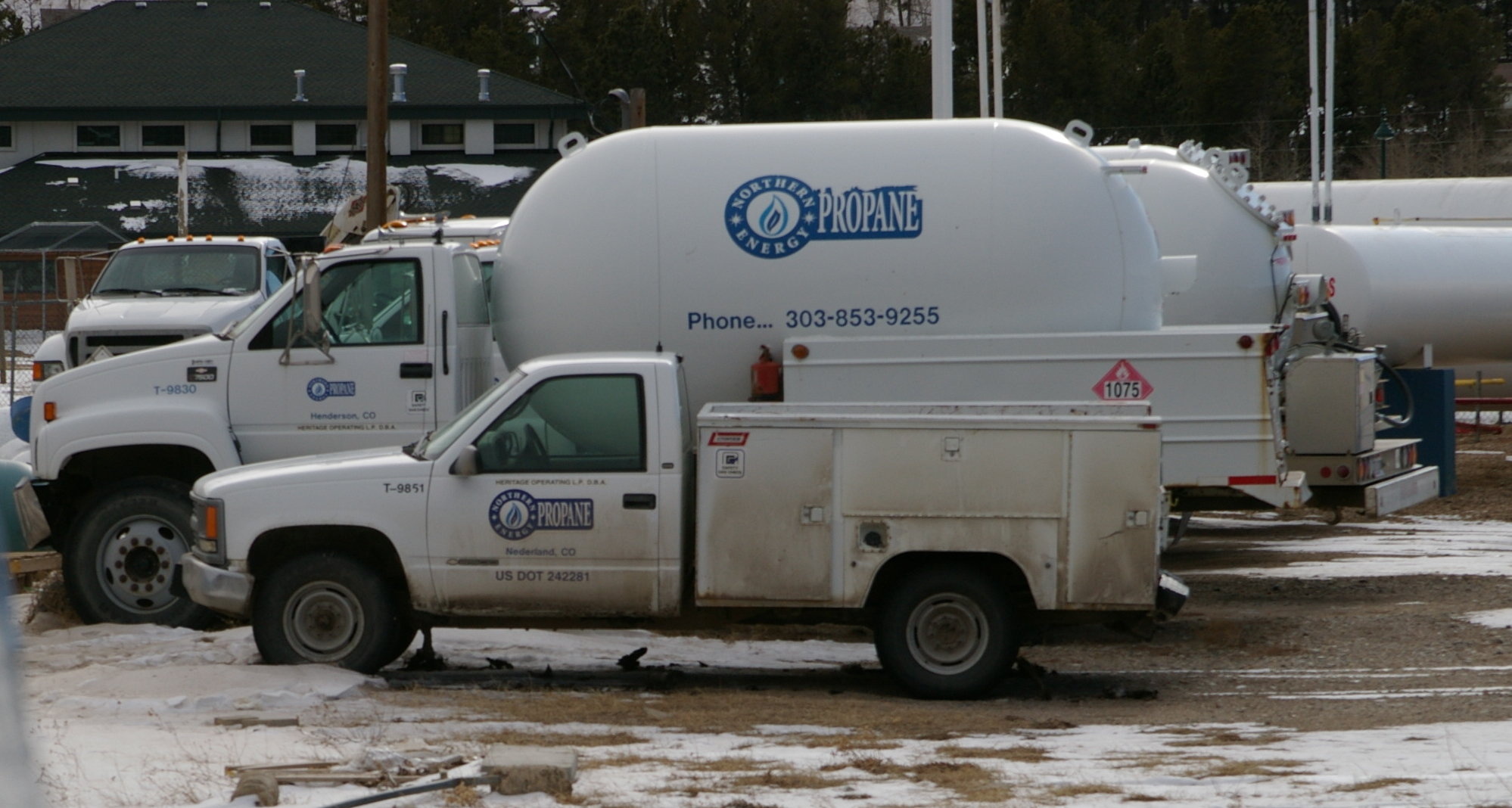
Liquefied Petroleum Gas is a commercial name for propane and butane, individually or in a climate-adjusted mix. At atmospheric pressure they are gases; at modest pressure or under mild refrigeration they are liquids that pack roughly 270 times more energy per unit volume than gas. Uses run across the board: cooking and home heating in rural US, India, and much of Latin America; autogas for taxis and buses in South Korea, Turkey, and parts of Europe; crop drying on farms; forklift fuel; and petrochemical feedstock for PDH and naphtha cracker supplement. The propane-to-butane ratio is adjusted seasonally and by latitude because butane will not vaporize reliably in cold weather.
The US Propane Export Boom
US propane exports grew from near zero in 2010 to over 1.5 Mbpd by 2025, making the US the world's largest propane exporter by a wide margin. The shale gas revolution, particularly from the Marcellus, Permian, and Eagle Ford basins, created a structural surplus of NGLs that far exceeded domestic demand. Enterprise Products' Morgan's Point terminal on the Houston Ship Channel and Targa Resources' Galena Park facility are the two largest US LPG export terminals, together capable of loading VLGCs (very large gas carriers) carrying 44,000 tonnes of LPG per voyage.
Destinations are primarily in Asia: Japan, South Korea, China, and India use imported propane for residential cooking gas, petrochemical feedstock, and industrial heat. The propane-naphtha spread determines whether Asian petchem crackers use propane or naphtha as feedstock. When US shale gas production is high and propane is cheap relative to naphtha, propane dehydrogenation (PDH) plants in China run at full rates, producing propylene for the polypropylene market. China brought over 15 PDH units online between 2014 and 2025, each consuming 15,000 to 20,000 bpd of propane. This structural demand has made the US Gulf Coast-to-Asia propane trade one of the largest single-commodity shipping routes in the world. Chapter 3 (Components) covers NGL fractionation and Chapter 10 (Petrochemicals) covers the downstream chemistry.
Lubricant Base Oils and the Group I to V Classification
Lubricant base oils are a small but high-margin product made from vacuum gas oil (VGO) via a sequence of severe hydroprocessing steps. The API 1509 classification divides them into five groups. Note carefully what is being classified. These are base stocks, the oil before anything is added to it, and not the finished product in the bottle. A finished motor oil is a blend, and it can draw on more than one group at once.
Table 9-8: API Group I to V base oils
| Group | How it is made | Typical use |
|---|---|---|
| Group I | Solvent refined, <90% saturates, >0.03% sulfur | Legacy industrial oils; being phased out |
| Group II | Hydrocracked, 90-99% saturates, very low sulfur | Mainstream automotive motor oils |
| Group III | Severely hydrocracked and hydroisomerized; very high viscosity index (VHVI) | Synthetic-labeled motor oils in North America (e.g., most "full synthetic" SAE 0W-20) |
| Group IV | Polyalphaolefins (PAO), chemically synthesized from ethylene-derived alpha-olefins | True synthetic lubricants, aerospace, racing, premium automotive |
| Group V | Everything else: esters, naphthenics, polyol esters, polyalkylene glycols | Specialty additives and niche formulations |
In North America, a decision by the National Advertising Division in the 1999 Mobil-versus-Castrol dispute allowed Group III hydrocracked base oil to be marketed as "full synthetic," even though chemically it is still a refined petroleum stream. Most "full synthetic" motor oils sold at US retail today are Group III blends, not PAO (Group IV), and the arithmetic of the base oil market makes that unavoidable. Group III and Group III+ together account for roughly a sixth of world base oil supply, while PAO capacity worldwide is under a million tonnes a year against a base oil market above thirty million tonnes, a low single-digit percentage of the total. There is not enough polyalphaolefin in existence for the shelf of bottles marked full synthetic to be made of it. Chapter 7 (Refining) covers the hydrocracker and hydroisomerization units that make Group II and III feed.
Other jurisdictions answered the same question the opposite way. Germany's Federal Court of Justice ruled in June 2018 (case I ZR 157/16) that selling a substantially hydrocracked Group III oil as vollsynthetisch is misleading, because German buyers had come to understand the word as meaning a base oil consisting almost entirely of polyalphaolefins or dicarboxylic acid esters. The court was explicit that the oil's measured performance was beside the point: what had been misrepresented was the product category the oil belonged to, not its quality. Group III products are consequently sold there under softer wording such as "synthetic technology." The same base stock can therefore be a full synthetic on one side of the Atlantic and a mislabeled one on the other, which is the thing to remember whenever a marketing word is doing work that no specification has defined.
Between the two sits gas-to-liquids base oil, sometimes called Group III+. Shell's Pearl plant in Qatar builds base oil out of natural gas by Fischer-Tropsch synthesis rather than separating it out of a barrel of crude, and sells it as PurePlus. On any plain reading of the word that oil is synthesized. It is classified as Group III all the same, because API 1509 sorts base stocks by what they measure, saturates content, sulfur and viscosity index, and not by how they were made. It is the clearest demonstration of what the group table does and does not tell you.
Semi-synthetic oil, sold in the US as "synthetic blend," appears nowhere in Table 9-8, and that absence is the answer rather than an oversight. It is not a base stock category at all. It is a finished product blended from a mineral base stock, usually Group II, with some proportion of Group III, Group IV or Group V added. The words synthetic, semi-synthetic and synthetic blend do not appear in API 1509 or in any other API document, no minimum synthetic content is defined anywhere, and no blender is obliged to disclose the ratio. Blends commonly run somewhere between 10 and 30 percent synthetic stock, but a bottle at 5 percent may carry the same words on the front label. Anyone who wants to know what is actually in the container has to go to the product data sheet, and frequently it is not stated there either.
The Additive Stack
Modern engine oil is roughly 75 to 80% base oil and 20 to 25% additive package by volume. The additive package is where much of the value and intellectual property sits. Key additives include ZDDP (zinc dialkyldithiophosphate), the most important anti-wear compound and the reason engine oils contain zinc and phosphorus; viscosity index improvers, which are polymers that thicken the oil at high temperature to maintain a protective film; detergents that keep internal engine surfaces clean; dispersants that hold soot particles in suspension rather than letting them agglomerate; pour point depressants that keep the oil flowing in cold weather; and antifoam agents. The additive market is concentrated among a handful of companies including Lubrizol, Infineum (Shell/ExxonMobil JV), Afton Chemical, and Chevron Oronite.
Viscosity Grade, Service Category and OEM Approval
Viscosity grading follows the SAE (Society of Automotive Engineers) system. A label like SAE 5W-30 means the oil behaves like SAE 5 weight at cold start (W for Winter) and SAE 30 weight at operating temperature. Multi-grade oils dominate modern passenger vehicles because they cover both cold-start flow and high-temperature film strength. The trend has been toward ever-thinner oils (0W-20, 0W-16) to reduce friction and improve fuel economy, which in turn demands higher-quality base oils (Group II and III) and more sophisticated additive packages.
Beside the viscosity grade sits the API service category, the two-letter code printed in the circular "donut" on the back of the bottle. The S series covers spark-ignition gasoline engines and the C series compression-ignition diesel engines. The gasoline series has worked through the alphabet as engines have changed: SN arrived in October 2010, SN PLUS was licensed from May 2018 to add a test for low-speed pre-ignition in turbocharged direct-injection engines, and SP superseded both in May 2020 alongside the ILSAC GF-6 standard. The categories are backward compatible, so an SP oil covers an engine that originally called for SN. The point worth holding on to is that a service category records how the finished oil performed in a defined set of engine tests. It says nothing at all about the base stock underneath it. An API SP oil can be Group II mineral stock, Group III, PAO, or any blend of them, and the donut reads the same either way.
The same two letters mean something else entirely in the base oil trade, which is a durable source of confusion. There, SN stands for Solvent Neutral, the traditional Group I designation, the number giving the approximate Saybolt viscosity at 100°F. SN 150 and SN 500 remain the workhorse grades quoted in Asian and Middle Eastern base oil markets. So API SN is a performance level near the top of the ladder, while SN 500 is a Group I base stock near the bottom of it, and the two have nothing to do with one another.
OEM lubricant specifications have proliferated. BMW LL-01, VW 502.00/505.00, Mercedes-Benz 229.5, and GM Dexos 1 (gasoline) and Dexos 2 (diesel) are proprietary specs that go beyond SAE viscosity grades to dictate additive chemistry, volatility, and performance test results. These specs effectively lock vehicle owners into specific oil formulations and create segmented markets within the broader lubricant industry.
Mineral oil (white mineral oil) is a colorless, odorless, tasteless base oil used in products from baby oil to bakery pan oils. Petroleum jelly (Vaseline) is a semi-solid mix of paraffin wax, mineral oil, and microcrystalline wax, one of the oldest petroleum products still in daily use since the 1870s.
Waxes
Paraffin wax is the solid, high-melting-point hydrocarbon that precipitates out of the lube oil dewaxing process. Food-grade paraffin coats cheese and candy wrappers; non-food paraffin goes into candles, crayons, cosmetics, and packaging. Microcrystalline wax is a tougher, smaller-crystal wax from heavier residues and is used in chewing gum, laminations, and rubber compounding. Global wax demand is on the order of 5 million tonnes per year. The market is small relative to fuels but has limited substitutes in most end uses.
Petroleum Coke
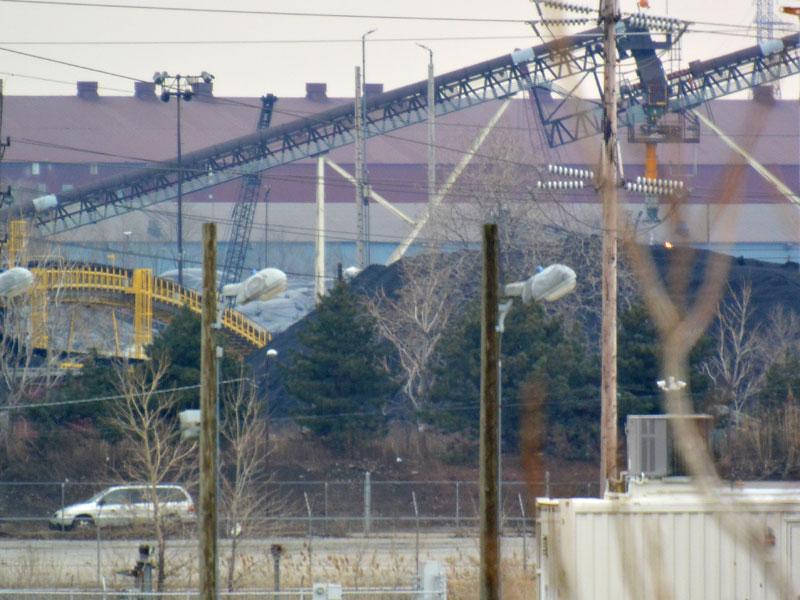
Petroleum coke is the solid carbon residue from a delayed coker. It comes in two economically distinct grades. Fuel-grade coke is high in sulfur and metals and is burned as a cheap coal substitute, mostly in cement kilns and power plants in Asia. It is controversial as an air quality matter but remains a large-volume export from the US Gulf Coast. Anode-grade coke is made from low-sulfur feedstock and then calcined at 1,200 to 1,400 degrees Celsius in rotary kilns to produce calcined petroleum coke (CPC). CPC is the critical input for the carbon anodes consumed during aluminum smelting. The global aluminum industry uses roughly 25 million tonnes of CPC per year. Quality requirements are strict: sulfur below 3%, low metals (vanadium, nickel, iron), and specific density and porosity specs that determine how evenly the anode erodes during electrolysis. Rain Carbon, Oxbow, and BP are the major independent calciners.
Graphite needle coke, a higher-purity form, is used for the electrodes in electric arc furnace (EAF) steel mills. Needle coke is the most expensive form of petroleum coke and usually comes from aromatic-rich feedstock. The supply chain became a strategic concern as China expanded both its aluminum smelting and EAF steelmaking capacity.
Fuel-grade coke is the high-sulfur, high-metals version burned as a cheap coal substitute in cement kilns and power plants, mostly in India and China. It is a large-volume US Gulf Coast export. Environmental pressure is mounting, particularly in India where petcoke burning contributes to urban air pollution, but cost advantages keep it in the fuel mix.
Bitumen and Asphalt
Bitumen is the heaviest fraction of the vacuum residuum, a black semi-solid that becomes a Newtonian fluid when heated. The dominant commercial use is road paving: bitumen binds crushed stone into hot mix asphalt, which paves roughly 94% of paved roads in the United States. The Superpave Performance Grading (PG) system specifies asphalt binders by their high and low service temperature, for example PG 64-22 for a binder that performs at 64 degrees Celsius hot-day pavement and -22 degrees Celsius cold-night pavement. Roofing shingles are the second-largest use, typically a blown or oxidized asphalt tougher than paving grades. The North American asphalt market went through a supply squeeze after 2010 as Canadian bitumen shifted from domestic upgrading to pipeline export and Mexican and Venezuelan heavy crude receipts declined.
Asphalt supply is tightly linked to heavy crude availability. The vacuum residuum from heavy sour crudes (Maya, Arab Heavy, Western Canadian Select) is the primary asphalt feedstock. When Venezuelan production collapsed after 2015 and Canadian pipeline constraints limited heavy crude flows to US Gulf Coast refineries, the asphalt pool tightened and prices rose. Refiners with access to heavy crude and vacuum distillation capacity have a natural advantage in the asphalt market.
Demand is seasonal. Road construction peaks in late spring through early fall, and asphalt prices follow their own seasonal cycle with highs in Q2 and Q3. State and federal highway budgets drive long-term volume; the US Infrastructure Investment and Jobs Act (2021) authorized significant new road spending that supported asphalt demand into the mid-2020s.
Kerosene and Niche Products
Outside the jet fuel market, straight kerosene remains meaningful as a home heating fuel in Japan and Korea, as a lamp and cooking fuel in parts of Africa and South Asia, and as a cleaning solvent and thinner. It is essentially absent from the US retail market but globally still runs into the hundreds of thousands of barrels per day.
Carbon Black and Sulfur
Carbon black is a fine powdered elemental carbon produced by the partial combustion of heavy oil fractions or natural gas. More than 90% of global carbon black goes into tires as a reinforcing agent, with the rest going into plastics pigment, printing inks, and, increasingly, lithium-ion battery electrodes. World production is on the order of 15 million tonnes per year.
Sulfur is the unavoidable byproduct of hydrotreating sour crude. The standard recovery method is the Claus process: hydrogen sulfide (H2S) gas produced during hydrodesulfurization is partially oxidized with air and then reacted over a catalyst bed to yield elemental sulfur, a bright yellow solid. Every refinery and sour gas plant with a hydrotreater has a Claus unit (or its modern equivalent, a tail gas treatment unit) somewhere in the process train.
As IMO 2020 and ULSD rules have forced deeper desulfurization, refinery sulfur output has risen relentlessly. Global elemental sulfur production now runs above 80 million tonnes per year, roughly two thirds from oil and gas sector recovery. The dominant downstream use is sulfuric acid, which is the world's most-produced commodity chemical by volume and is used to make phosphate fertilizer (the single largest end use), for metal extraction (copper, nickel, zinc), and for industrial acid processes. Rubber vulcanization and fungicide production round out the market.
The "sulfur problem" is geographic: too much sulfur in the wrong place. Canadian oil sands upgraders near Fort McMurray produce massive sulfur blocks that sit in open-air storage because the cost of transporting the sulfur to a buyer exceeds its market value. These yellow sulfur pyramids are visible from satellite imagery. Middle East sour gas processing (particularly in Abu Dhabi and Kazakhstan) faces a similar surplus. The global sulfur market balances precariously: fertilizer demand in Africa, India, and Brazil absorbs the surplus, but transportation costs make it a logistically challenging trade.
Global Refined Product Trade Flows
Finished products move on different trade routes than crude oil. Refineries are concentrated in consuming regions (US Gulf Coast, Northwest Europe, East Asia) and in crude-exporting regions with upgrading capacity (Saudi Arabia, India, South Korea). The largest product trade flows reflect both geographic refinery advantages and shifting geopolitics.
Table 9-9: Major refined product trade routes (2024, approximate)
| Route | Primary product | Volume |
|---|---|---|
| US Gulf Coast to Latin America | Gasoline, diesel | 1.5 to 2.0 Mbpd |
| US Gulf Coast to Europe | Diesel, jet fuel | 0.5 to 1.0 Mbpd |
| Middle East to Asia | Naphtha, fuel oil, LPG | 2.0 to 3.0 Mbpd |
| India to Africa and Europe | Diesel, gasoline | 1.0 to 1.5 Mbpd |
| Russia to Turkey, India, and China | Diesel, fuel oil (rerouted post-sanctions) | 1.0 to 1.5 Mbpd |
The post-2022 rerouting of Russian product exports is the most significant structural shift in product trade since IMO 2020. EU sanctions on Russian petroleum products (February 2023) redirected Russian diesel and fuel oil from its traditional European buyers to Turkey, India, and China, while Middle Eastern and Indian refiners backfilled European diesel demand. Trade routes lengthened, tonne-miles increased, and product tanker rates rose.
Transportation fuels (gasoline, diesel, jet fuel, and residual fuel oil) account for about 64% of global crude oil consumption. The remaining 36% goes to petrochemicals, heating, industrial fuel, road construction, lubricants, and other uses covered in this chapter and Chapter 10 (Petrochemicals).
The above was updated in 2026. For the full original 2009 chapter, download the 1st edition 2009 PDF.