Chapter 26
Iran Blocks the Strait
The 2026 Strait of Hormuz crisis: 12 Mbpd shut in, Dubai crude at $166, the June deal that failed, Iran's unrecognised toll route, and 12 standing lessons.
The Chokepoint
The Strait of Hormuz is the most concentrated energy risk on earth. At its narrowest it is 21 miles wide, and all commercial traffic funnels through a shipping lane just six miles across: two miles inbound, two miles of buffer, two miles outbound. Through that corridor moves roughly 20 million barrels a day of crude oil, refined products, and LNG, about a fifth of global petroleum liquids consumption. No other passage on earth carries more energy value, and there is no quick way around it: the alternatives are pipelines that move less than half the volume, and they take years to build.
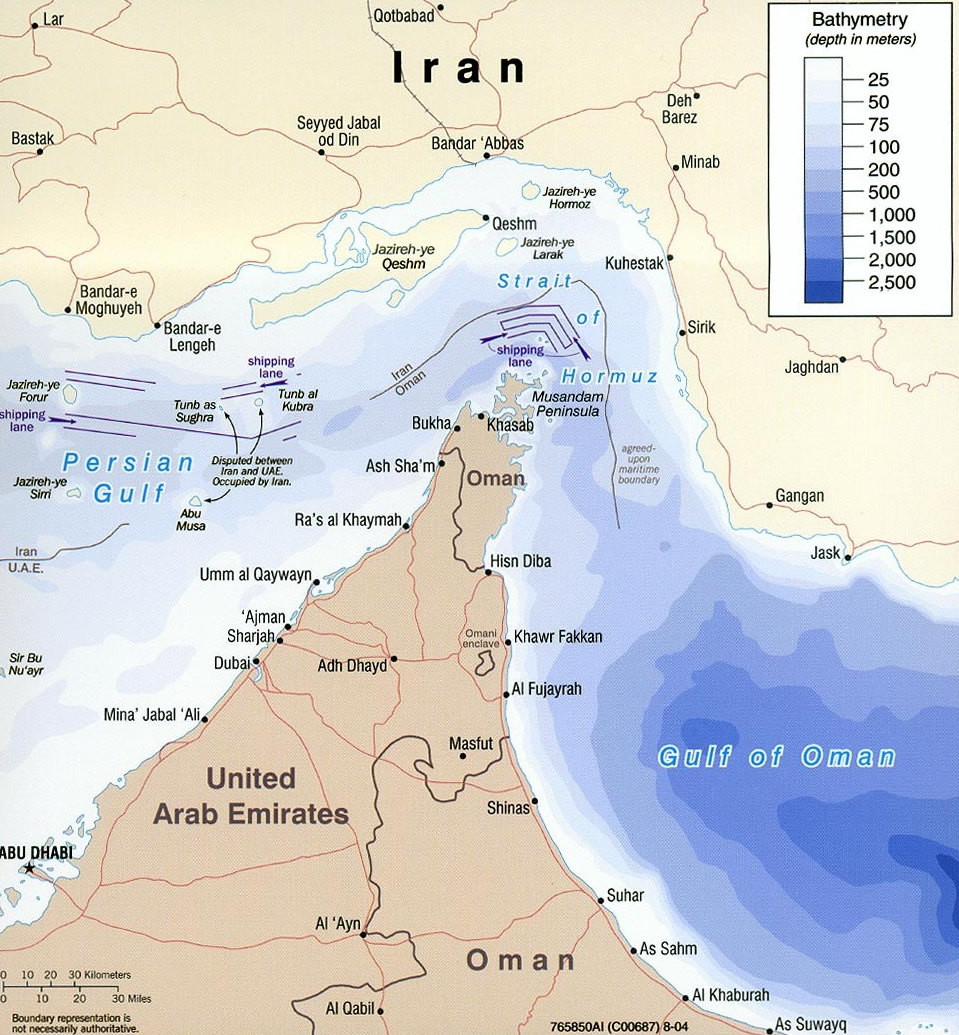
For four decades, oil traders, military planners, and energy analysts rehearsed a Hormuz closure as the ultimate tail risk and priced its probability at close to zero. On February 28, 2026, the rehearsal ended. Nearly four months later it appeared to end: an interim deal struck on June 14 and signed on June 17 reopened the strait, lifted the US naval blockade and oil sanctions, and ended Iran’s shipping restrictions, with a 60-day window to negotiate Iran’s nuclear program. Crude collapsed on the news, falling roughly 15% in the week as tankers returned to the Gulf, and by the first days of July transits were back inside the pre-war band and the market had flipped from pricing a shortage to fearing a glut.
Then it came apart. Two tankers were struck on July 6 and 7, Trump declared the ceasefire over on July 8, and by late July transits had fallen to roughly 13 a day, war-risk premiums were back near their crisis peak, and Brent had repriced from $69 to $105. The most useful thing about that reversal is what it teaches, which is that a chokepoint does not reopen because a document says so. It reopens when insurers, shipowners, and masters believe it has, and belief is rebuilt slowly and destroyed in an afternoon. This chapter therefore treats the 2026 closure not as a bounded historical episode but as a live case study in how a chokepoint shock propagates, why it is so much harder to reverse than to cause, and what structural lessons it has already left behind. The chronology sits in a single timeline table further down. The live status block above tracks where it stands today.
Anatomy of a Closure
A strait closure does not hit the market all at once. It propagates in a sequence: insurance and shipping freeze first, prices reprice on the threat before a single barrel is physically short, production shuts in because there is nowhere to put the oil, alternatives prove necessary but insufficient, and the inventory cushion determines how long the system holds before demand has to be rationed. The 2026 crisis ran the full sequence.
Insurance and shipping freeze first. Within 48 hours of the first IRGC radio warnings, at least three tankers were struck and incoming traffic dropped to near zero. War-risk insurance, not military force, is what actually closes a strait. As attacks mounted, protection and indemnity clubs withdrew war-risk coverage, premiums on hull value blew out from a fraction of a percent to multiples of it, and vessels still moving switched off their AIS transponders or broadcast false positions to avoid being targeted. A tanker cannot sail without coverage, and no underwriter will write a policy on a route where ships are being sunk. By mid-March at least 28 attacks had been confirmed or claimed: one tug sunk, 16 merchant ships damaged, twelve seafarers dead or missing. The waterway was technically still open. It was commercially dead.
The Price Shock
Brent closed at $71.32 on February 27, the last session before the attack. It crossed $100 on March 12, $118 on March 18, and reached its crisis high of $138.21 on April 7, a 94% gain in under six weeks. As the physical market tightened, Dubai crude, the benchmark for Middle Eastern sour grades, reached $166 on March 19, exceeding the July 2008 all-time high of $147 for WTI. It was the most expensive barrel of crude ever traded in nominal terms, and the fact that a sour Gulf grade outran Brent by $50 is the whole story of the closure in one number: the barrels that could not move were the Gulf barrels. The Hormuz closure compressed a larger move than the 2022 Russia-Ukraine shock into a fraction of the time.
European natural gas followed. Prices roughly doubled in a week after Qatar, the world's second-largest LNG exporter, stopped production on March 2 and declared force majeure on March 4. European buyers who had congratulated themselves on replacing Russian pipeline gas with Qatari LNG discovered their new supply chain ran through the same six miles of water. The shock rippled into adjacent commodities: urea fertilizer up 50% by late March (the Gulf supplies roughly 30% of globally traded fertilizer), helium rationing, sulfur supply to US industry near-totally disrupted. Once talks were signaled the price stopped tracking barrels and started tracking diplomacy, snapping up and down on each headline about whether and on whose terms the strait would reopen.
The July round trip shows that better than anything else in the episode. Brent fell to $68.53 on July 2, below where it started the year, on nothing more than the belief that the deal would hold. Attacks resumed, the ceasefire was declared over on July 8, and the price went to $105.32 by July 23, a 54% move in three weeks with no change in the underlying reserve base, refinery fleet, or demand curve. Brent finished July up 24% and WTI up 21%, the largest monthly gains since the crisis began in March. Then on August 3, after Trump called off a planned strike and announced talks, Brent fell about 5% in a session. Nothing physical moved on any of those days. What moved was the market’s estimate of whether ships would sail, which is the point: in a chokepoint crisis the price is a probability, not an inventory. As one analyst put it at the end of July, the market had stopped trading the war and started trading the shipping data.
Figure 26-3: Brent Crude, Gulf Coast Diesel, and Jet Fuel (US$/bbl) Jan-Jul 2026
Forced Shut-Ins
Gulf producers did not cut output voluntarily. They cut because they had nowhere to put the oil. With tanker loading suspended and onshore storage filling, the shutdowns were forced. Iraq dropped from 4.3 to 1.3 Mbpd by March 8 and began shutting Rumaila, its largest field, on March 17 after storage was exhausted. Saudi Arabia cut 20%, from roughly 10 to 8 Mbpd, shutting offshore fields including Safaniya, the world's largest. Kuwait and Qatar declared force majeure. By March 30 regional exports had fallen 60%, from roughly 25 to 10 Mbpd, the largest involuntary production shut-in in the history of the oil industry. The 2020 COVID cuts removed a similar volume, but those were voluntary and coordinated through OPEC+. These were the consequence of a physical blockade.
The restart, when it came, was uneven, and the ranking tells you who had a bypass. The UAE was first back to pre-war export volumes, because Habshan-Fujairah lets it load outside the strait at all. Saudi Arabia came close behind on the Petroline route to Yanbu. Iraq, with the least bypass capacity of the three, lagged both, restoring output at three southern fields only in early July once Gulf loadings resumed, and then losing them again when the truce collapsed days later. OPEC+ meanwhile spent the crisis raising quotas into a market that could not physically lift the barrels, approving a fifth consecutive increase of 188,000 bpd for September and completing the unwind of the roughly 3.5 Mbpd of voluntary cuts agreed in 2023. The group then paused further increases for the fourth quarter, leaving about 2 Mbpd of the 2022 cuts in place. Most of that restored quota was paper. A production quota is permission to produce, not a route to a buyer, and for the members behind Hormuz the constraint was never the quota.
Table 26-1: Hormuz Transit by Exporter (2024, Pre-Crisis)
| Country | Crude + Condensate (Mbpd) | Notes |
|---|---|---|
| Saudi Arabia | 5.5 | Eastbound cargoes; westbound via Red Sea bypasses Hormuz |
| Iraq | 3.3 | Basra oil terminal; Kirkuk-Ceyhan exports bypass Hormuz |
| UAE | 2.5 | Partly bypassed via Habshan-Fujairah pipeline (1.5 Mbpd cap.) |
| Kuwait | 1.7 | All exports transit Hormuz; no bypass pipeline |
| Iran | 1.5 | Kharg Island; Iran exempted own and allied cargoes |
| Qatar | 0.5 + LNG | Small condensate volumes; massive LNG exports (80 Mtpa) |
The Bypass Pipelines and Their Ceiling
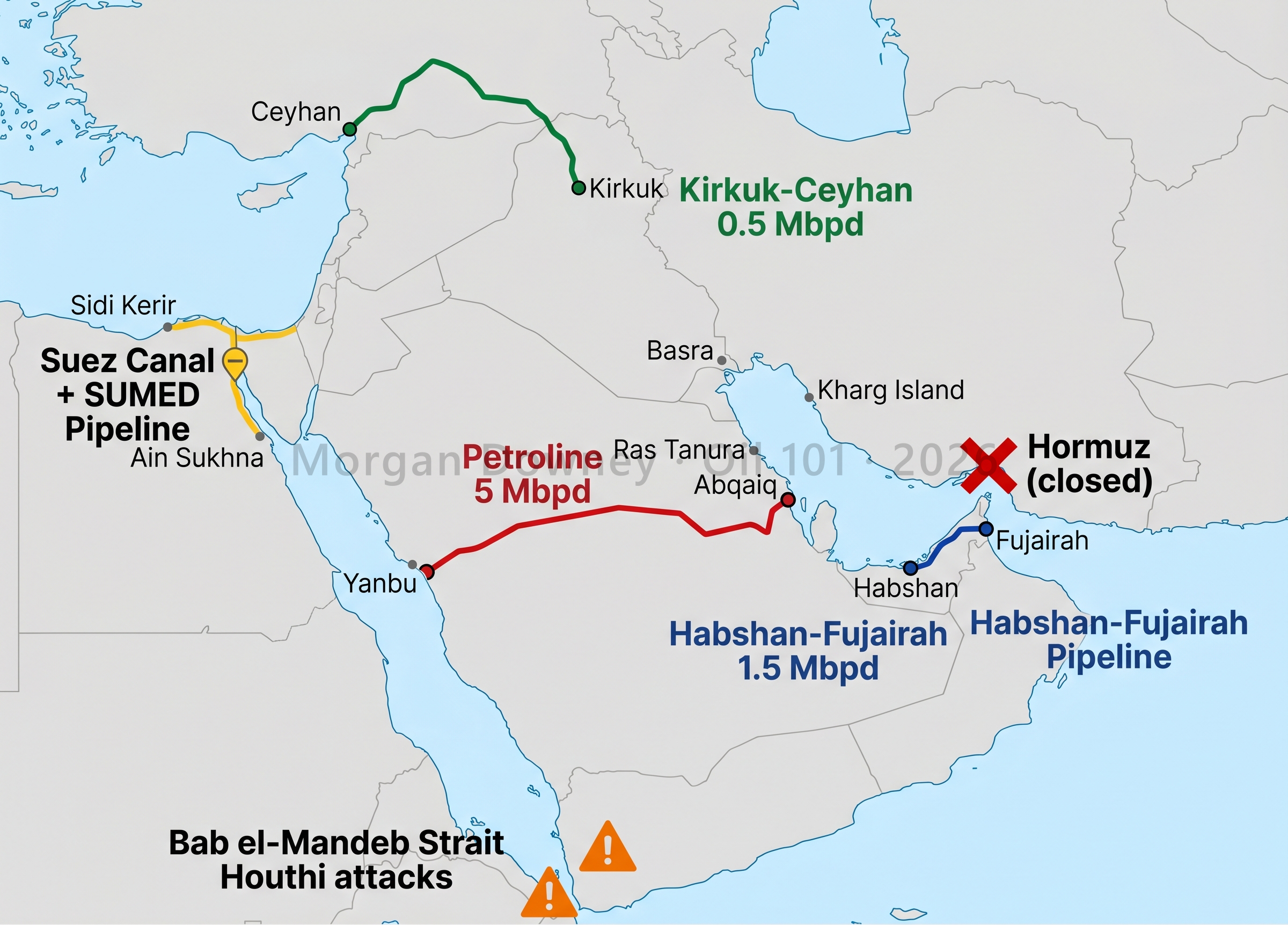
Three pipelines can move Persian Gulf crude to ports that do not require Hormuz transit, and all three were activated within two weeks of the closure. The Saudi East-West Pipeline (Petroline) runs from Abqaiq to the Red Sea port of Yanbu, roughly 5 Mbpd of capacity, and Saudi Arabia had kept it partially loaded for exactly this contingency. The UAE Habshan-Fujairah pipeline moves Abu Dhabi crude to the Arabian Sea coast at Fujairah, bypassing Hormuz entirely, roughly 1.5 Mbpd. The Iraq Kirkuk-Ceyhan line moves northern Iraqi crude overland through Turkey to the Mediterranean, roughly 0.5 Mbpd.
Combined bypass capacity is roughly 7 to 9 Mbpd against the 20 Mbpd that normally transits Hormuz. The pipelines covered less than half the lost volume; the remaining gap, roughly 11 Mbpd of stranded production, was the largest involuntary supply shortfall the oil market has ever seen. There is a further trap. The Yanbu route sends crude into the Red Sea, which as of early 2026 was still under Houthi attack (see Chapter 11 (Transporting Oil)). Bypassing Hormuz only exposed cargoes to the Bab el-Mandeb. The world's two most important oil chokepoints were compromised at once.
The bypass ceiling can now be watched rather than estimated. An independent tracker at hormuzstraittracker.com publishes a daily estimate of liquids moving through the strait, built from MarineTraffic AIS positions and Sentinel-1 and Sentinel-2 imagery against export baselines from the IEA and Kpler. It is not an official source and its operator is not named, so treat it as a well-documented method rather than as an authority, and check it against the UKMTO and JMIC advisories and IMF PortWatch. Its value is that it separates the two numbers this chapter keeps having to distinguish.
At the end of August 2026 it put strait flow at 19.7 million barrels a day on a seven-day average, about 91 percent of a 21.6 million barrel pre-war baseline, with the single most recent day at 15.8 million, or 73 percent. That gap between the week and the day is the crisis in one line: the average says the strait works, and the daily number says it works unpredictably, which is what actually prices a cargo. The second number is the one that belongs in this section. Incremental exports rerouted through the Red Sea, which is the East-West pipeline doing what it was built to do, ran at about 0.6 million barrels a day. Set that against a 21.6 million baseline and the bypass is recovering under three percent of what the strait carries. The ceiling described above is the observed limit rather than a theoretical one.
By September 12 the same tracker put strait flow at 1.9 million barrels a day against a baseline it now states as 20 million, under a tenth of normal, with Red Sea rerouting at 1.2 million on a fourteen-day average. Al Jazeera counted eight vessels of all types transiting on Monday September 7, against roughly 130 a day before the war. Treat the precise figures with the caution the method deserves, since the tracker restated its own pre-war baseline from 21.6 million to 20 million between those two readings and its published components do not sum to its totals. The direction is beyond dispute. The partial recovery of August is gone.
September then added a third limit that the first two had assumed away. On September 10 drones launched from Maysan province in southeastern Iraq struck the East-West pipeline at points in the Riyadh and Madinah regions, injuring several people, and NASA thermal data and satellite imagery showed fires burning south of Madinah. Saudi Arabia shut the line the following day as a precaution and has published no damage assessment. Baghdad condemned the attack, dismissed its Maysan operations commander and closed the Shalamcheh crossing with Iran, while Riyadh deferred retaliation at the Iraqi prime minister’s request and reserved the right to act. Open-source analysts reported damage at the connected Abqaiq complex from satellite imagery, though those readings conflict with each other and no official assessment exists, so the scale of it remains unestablished.
The other end closed in the same week. Houthi forces took the port of Mocha and then, on September 11, Perim Island, the volcanic rock that splits the narrowest part of the Bab el-Mandeb into two shipping lanes, completing their control of Yemen’s Red Sea coastline. Their spokesman said navigation remained safe for every company except Saudi ships, which were already banned. So the pipeline built to avoid Hormuz was shut at the pump, and the strait it delivers into was closed to the one country that depends on it, inside about 48 hours.
That sequence is the point this section was already circling. A bypass is infrastructure, and infrastructure can be aimed at in a way a sea lane cannot: a pipeline is fixed, its pumping stations are mapped, and it can be reached by a drone flown from a third country that is not party to the war. The harder problem is that the redundancy was correlated. The alternative route out of the Gulf ends in a strait held by a party aligned with the one closing Hormuz, so the two failures were never independent, and a planner who counted them as separate options was counting one risk twice.
A Two-Tier Market
Iran did not close the strait to everyone. It closed it selectively, and in doing so created a two-tier global oil market with no modern precedent. By late March, Iran was permitting transit for vessels from a handful of friendly states (China, Russia, India, Iraq, Pakistan, later others) while declaring the strait closed to all traffic to and from the United States, Israel, and allied ports. The blockade was not universal; it was directional. Iran was using Hormuz as a sorting mechanism: partners could transit, adversaries could not.
That bifurcated the price of crude itself. Asian-delivered Gulf barrels, moving under Iranian permission, traded at one level; Atlantic-basin crude, cut off from Gulf supply, traded at a scarcity premium. Iran then added a financial layer, running a channel north of Larak Island and charging tolls that exceeded $1 million per vessel, reportedly assessed in Chinese yuan, with at least one ship paying $2 million. It was a piracy tax wrapped in sovereignty language. The strait had stopped being infrastructure and become leverage: any nation that wanted Gulf oil had to deal directly with Tehran.
Two Routes, Neither Official
The most durable thing Iran has achieved is the rerouting rather than the closure. In April it declared its own transit corridor through the strait, hugging the Iranian coast, and began treating compliance with that route as the condition of safe passage. The corridor has never been approved by the International Maritime Organization and is recognized by neither the United States nor the European Union. It exists because ships use it, and ships use it because the alternative is being shot at.
The numbers show how fast a legal fiction can become a fact. The chapter opened by describing the Traffic Separation Scheme, the six-mile corridor that has carried a fifth of the world’s oil for half a century. That scheme is now effectively abandoned. Traffic has split between two unofficial alternatives: Iran’s declared route to the north, and a southern track through Omani territorial waters, outside the scheme altogether, which the US-led Joint Maritime Information Center widened in late June specifically to give owners somewhere to sail that was not Iran’s. During the truce the split ran roughly 60% Iranian route and 40% Omani. When the truce broke it went to 90% Iranian in the week to July 22, and on at least one day every single vessel that crossed used Iran’s corridor. The following week it swung back the other way as owners chose the Omani coast instead. The two routes now function as a live referendum, run daily, on whose writ covers the strait.
Almost all of it moves in the dark. Roughly 70% of weekly traffic in late July ran with no AIS signal at all, and of 22 non-Iranian transits in one week, 21 were dark. A waterway that the entire market once tracked in real time has gone substantially unobservable, which is its own kind of damage: price discovery in shipping depends on knowing what sailed. Iran’s stated objective through all of this has been consistent and is commercial as much as military. It wants vessels to follow routes and protocols it sets, and it wants to charge them for the privilege. Washington and the Gulf states reject the claim outright. But the claim is being settled in practice rather than in law, one transit at a time, and the side that can credibly threaten a hull is currently winning it. That is the precedent this crisis leaves behind, and it is available to any state that sits beside a narrow waterway.
Since August 17 the claim has grown a price. When the 60-day agreement expired, Iran began enforcing a transit and fee regime: comply with the route and the charge, or face enforcement. It demonstrated both halves within 48 hours, seizing the products tanker Amara near Qeshm and putting a projectile through the engine room of the bulk carrier Minoan Dignity in the southern corridor, killing her chief engineer. That is a different thing from a blockade and a different thing from a war risk premium. A blockade stops traffic and a premium prices danger, but a toll assumes the traffic continues and charges it, which means the party collecting has an interest in the waterway staying open.
It is also the oldest idea in maritime commerce arriving in the most modern setting. Sound dues at the entrance to the Baltic, the chain across the Bosphorus, the Danish crown taxing every hull that passed Kronborg for four centuries: a narrow water and a state beside it has always tended toward a toll booth, and the modern law of the sea exists largely to prevent exactly that. What is being tested in Hormuz is whether transit passage survives contact with a state willing to enforce a fee. Nothing in the treaty framework has changed. What has changed is that the fee is being collected.
Who Is Most Exposed
The countries most dependent on Hormuz are, by definition, the ones that import the most Gulf oil, and the list is dominated by Asia. China, Japan, South Korea, and India together account for roughly 60% of Hormuz-transiting crude. Europe's crude exposure is lower because it leans on the North Sea, Russia, West Africa, and the Americas, but its Qatari LNG imports are nearly 100% Hormuz-dependent. The United States, a net petroleum exporter since the shale boom, is the least directly exposed major economy (see Chapter 1 (A Brief History of Oil)).
Table 26-2: Major Importer Hormuz Exposure
| Country | Hormuz Share of Oil Imports | Strategic Reserve Days | Bypass Options |
|---|---|---|---|
| Japan | 80% | 140+ | None; island nation, no pipeline alternatives |
| South Korea | 70% | 90+ | None; peninsula, no pipeline alternatives |
| India | 60% | 40 | Limited; ISPRL reserves at Visakhapatnam, Mangalore, Padur |
| China | 40% | 80-90 | ESPO pipeline; diversified to Brazil, West Africa |
| Europe (EU) | 15-20% | 90+ | North Sea, Norway, West Africa, Americas; but Qatar LNG at risk |
| United States | 5% | 80 | Domestically self-sufficient; SPR for global coordination |
Figure 26-5: Hormuz Exposure vs. Strategic Reserve Cover by Importer
SPR days of cover = total strategic reserves divided by total net imports from all sources, not just Hormuz. Sources: EIA, IEA, JOGMEC, KNOC, ISPRL, industry estimates (China).
Why Oil Hasn’t Broken $200
By the numbers this was a worse fundamental shock than 1973 or 1979. Cumulative supply shut-in since February 28 crossed 1.1 billion barrels, against roughly 4 to 5 Mbpd removed in each of the 1970s crises. Brent topped $147 in 2008 on a smaller imbalance. Yet Brent peaked at $138 on April 7 and has spent the crisis in a $69 to $138 range, well below the $200-plus scenarios banks and officials modeled in the first weeks, and it twice fell back near its pre-crisis level on nothing more than a diplomatic signal. Three buffers explain why the price never broke $200, and only one is conventional.
Strategic releases. On March 11 the IEA's members committed to release up to 400 million barrels, the largest coordinated SPR commitment ever, more than double the 2022 Ukraine release. But 400 million barrels is only about four days of global consumption, and the figure is an announced ceiling, not a delivery schedule. The US authorized 172 million barrels of that total. The reserve fell from 415 million barrels on February 27 to 374 million by May 15, to 307.7 million by July 24 and to 285.4 million in the week to September 4: a draw of roughly 130 million barrels and the lowest level since November 1982. When the authorized release is fully delivered the reserve is projected near 243 million. Two things make that worse than the headline. A May 2026 review by the Government Accountability Office found more than a quarter of the remaining inventory was unavailable anyway, stranded behind cavern outages and construction, so the deliverable reserve is materially smaller than the reported one. And the physical plant is tiring: pumps, pipelines, wells, and caverns built in the late 1970s have now been run hard through two emergency drawdowns in four years, and the maximum sustainable rate at which the reserve can actually deliver oil is a function of that hardware, not of the barrels on the books (see Chapter 12 (Storage)). The announcement worked mainly as a signal that governments would intervene at scale. The episode nonetheless left a clear verdict that the metal was worth it: days after the June deal, Saudi Aramco’s chairman said the company was weighing far larger oil-storage facilities around the world, pointing to China’s and the United States’ strategic stockpiles as the reason the disruption was not far worse. Strategic storage, long derided as idle capital, is the buffer that has bought all the time anyone has had.
Dark-fleet inventory. Iran's shadow fleet, the network of older tankers running with falsified or absent AIS signals, had been holding 100 to 180 million barrels at sea before the closure (Kpler and Vortexa estimates). As the strait shut and the US blockade tightened, Iran's onshore tank farms drained into the fleet, and those dark cargoes have been worked down through the spring, releasing supply the official OECD numbers never tracked, roughly 15 days of strait outage worth.
Inventory efficiency. The largest buffer is the least visible. Over the last decade, machine-learning demand forecasting and real-time supply-chain telemetry have cut the working inventory the oil system needs to run, on the order of 30% across the supermajors and large distribution systems. Applied to roughly 3 billion barrels of OECD commercial inventory, that is close to 1 billion barrels of structural buffer that did not exist in 2010. The toolkit is unglamorous, boosted-tree demand forecasters, AIS-derived shipment nowcasting, refinery-turnaround coordination, retail-offtake telemetry, and it produces no headlines. Tracking tanker AIS was the cutting-edge edge of 2010, and it is gone now that everyone has it; the next edge is in the silent AI-efficiency layer that never shows up in the inventory tally.
The combined effect was roughly a 130-day cushion. OECD commercial inventories fell more than 300 million barrels between February 28 and mid-June with no on-screen panic, the kind of drawdown that would have produced visible scrambling in 2010. None of these buffers is permanent: SPR refill is slow and politically expensive, the dark fleet is finite and has been drawn down, and efficiency only buys time, not new supply. The June 14 deal arrived with the cushion nearly spent, net oil-importer reserves down to roughly 200 million barrels, about three weeks short of the modeled run-dry.
This is the part of the story that the July reversal changed most. The deal was supposed to end the drawdown and start the refill. Instead the truce broke before restocking could begin, and the system went back into the closure with the cushion already spent rather than intact. That is why the second closure has repriced crude faster than the first: in March the market was arguing about how deep a buffer was, and by late July it could see the bottom of it. US commercial crude stocks fell to multi-year lows, the SPR is at a 1982 level, and the strategic-release lever has largely been pulled. August complicated that picture without reversing it. The IEA reported OECD commercial tanks building that month while non-OECD stocks drew and oil on water fell 65 million barrels, which is what happens when tankers stop sailing: cargoes already at sea discharge into shore tanks and are not replaced behind them, so an OECD build of that kind is a symptom of the blockage rather than a sign of comfort. Global observed inventories still fell 95 million barrels in August, and 507 million since February. The system absorbed the first four-month closure without breaking. It is now absorbing a second one with far less to absorb it with, and the $200 scenarios that looked hysterical in March are arithmetic rather than rhetoric if the strait stays shut through the autumn.
Figure 26-6: Global Oil Stocks Through the 2026 Hormuz Crisis
Sources: IEA Oil Market Report, DOE SPR Quick Facts, EIA, JOGMEC, KNOC, IEA Emergency Response Reviews. Days of coverage computed against roughly 104 Mbpd global consumption.
Figure 26-7: Global Strategic Petroleum Reserves by Country/Region, 1977 to 2026
Sources: EIA Weekly Petroleum Status Report (US SPR series WCSSTUS1), DOE SPR Quick Facts, JOGMEC, KNOC, IEA Emergency Response Reviews
The SPR Defends Crude, Not the Pump
The strategic releases did real work, but they revealed a limit that the headlines missed. A strategic petroleum reserve holds crude, not refined products. When the IEA members and the US drew down their tanks, they added crude to a market that was already being told crude was scarce, and it worked: front-month crude was capped, and once the deal landed it was crushed, falling from a $114 April peak to about $72 by late June. But no reserve on earth stores gasoline, diesel, and jet fuel at that scale. The scarcity did not vanish when crude fell. It moved one step down the barrel, from the crude price to the refining margin, where there is no strategic reserve to release and no government tool to cap it.
The measure of that transfer is the 3:2:1 crack spread, the refiner’s gross margin on turning three barrels of crude into two of gasoline and one of distillate. A normal 3:2:1 margin runs $10 to $20 a barrel. Through the spring it reached the mid-$50s, matching the territory of Hurricane Katrina and the 2008 dislocation. Then came the tell: as the releases and the June settlement pulled crude down, the margin did not follow it down. It climbed instead, moving in the opposite direction from the crude price. A consumer feels the pump, and the pump is a product price; the SPR is a crude tool. In 2026 the gap between the two, the refining margin, is where the crisis went to live once crude was contained.
July settled the argument. When the truce collapsed and crude repriced upward, the margin outran crude rather than merely keeping pace: the 3:2:1 reached $70.58 a barrel on July 21, roughly four times a normal margin, and August carried it further still, to $83.97 on August 31. That is the widest 3:2:1 in the twenty years of daily Gulf Coast data, ahead of the $80.60 reached during Hurricane Ike in September 2008. The diesel crack hit $90.46 on July 23 and cleared $100 again in early September, short of its own April 2022 high of $116.96. The gasoline crack reached its best level since June 2022. US refiners posted the most profitable quarter in the industry’s history while the pump price rose to about $3.95 a gallon, up nearly 80 cents on the year. Note what that combination means. Crude spent the same month round-tripping from $69 to $105 and back toward $84, so the refiner was not simply riding a crude rally. The margin widened because products were scarcer than crude, and the policy toolkit had nothing pointed at products at all.
Figure 26-8: US 3:2:1 Refining Margin vs WTI Crude (US$/bbl), 2026
Two refining systems were degraded at once, which is why the product side stayed tight long after crude cracked. Gulf refineries had cut runs or shut entirely when the strait closed, removing product supply at the source. At the same time, and for reasons unrelated to Hormuz, Ukraine’s long-range drone campaign against Russian refineries reached a record pace in the first half of 2026, with roughly 190 strikes, several times the prior year’s count and a monthly peak in May, knocking out large slices of Russian crude-processing and diesel output (see Chapter 7 (Refining)). Distillate, the tightest product globally and the one most exposed to both shocks, led the move: the diesel crack ran well above the gasoline crack for most of the crisis. The lesson for a policymaker is uncomfortable. Strategic reserves defend the crude price, and by extension the balance of payments and the macro shock, but they do very little for the price a driver or an airline actually pays, because that price is set one refining step further on, in a market no reserve can reach.
Anatomy of a Reopening
A strait reopens in the reverse order it closed, and far more slowly. Closure is a step change: the shooting starts, insurance vanishes overnight, and traffic falls to near zero within 48 hours. Reopening is a curve. It runs through a sequence of gates that clear one at a time, and a signed deal only opens the first of them. The chapter’s own timeline shows why: when Iran’s foreign ministry declared the strait “completely open” on April 17, the reopening lasted under 24 hours before its own navy fired on a tanker. A declaration is not a reopening. The gates are.
The shooting has to credibly stop, and stay stopped. Owners do not risk a $100 million hull and 2 million barrels of cargo on a ceasefire that has broken twice before. They wait for evidence the truce holds. The channel has to be cleared. Mines and unexploded ordnance do not disappear when a deal is signed; demining a waterway the width of Hormuz is a job measured in weeks, and a single drifting mine reverses confidence instantly. War-risk insurance has to re-rate down. This is the constraint on the way out, exactly as it was on the way in. Underwriters cut premiums slowly and only after a run of safe transits builds a track record; no policy, no sailing. And owners have to trust it enough to switch their AIS back on and route laden tankers through the strait rather than keep running dark or paying for the bypass pipelines. Each gate that clears lets a larger share of normal traffic return, so the recovery arrives as a rising percentage, not a reopening day: a thin trickle of cautious transits first, the bulk of volume over the following weeks as premiums fall, and full restoration of the roughly 20 Mbpd that normally passes lagging on the slowest gate, usually demining and the last holdout insurers, by a month or more. The 2026 reopening ran the pattern but compressed it: a thin, fragile rebound in the first days after the June 17 signing (71 transits over June 19 to 21, and a brief re-closure and fresh attacks in late June that briefly reversed confidence), then a fast completion once the truce held. The recovery did not return uniformly, and the composition matters. Oil and gas tankers came back first and fastest, because they carry the highest-value cargo and because Iran’s whole point of leverage was oil: by July 2, 35 tankers were clearing the strait in a day, back inside the pre-war band of 30 to 40. Total traffic of all ship types lagged well behind, roughly 258 transits in the week against 138 the week before but still far under the pre-war run rate of well over 100 vessels a day, because container ships and dry-bulk carriers can reroute around the Cape and were in no hurry to return to a strait that had been mined weeks earlier. The direction of the rebound was almost entirely eastbound and crude-heavy, laden VLCCs and Suezmaxes bound for Asia, where China and India alone take roughly 44% of Hormuz crude; the leading indicator that it would hold was the surge of empty tankers sailing back in ballast to reload (inbound ballast crossings up over 250%), a sign owners were betting on a sustained reopening rather than a one-off dash. That the gates cleared in weeks rather than the modeled month-plus is precisely what flipped the market from shortage to glut.
Then every gate closed again, in days, and the sequence in reverse is the most instructive thing in this chapter. The shooting restarted first. Two tankers were struck on July 6 and 7, including the Qatari LNG carrier Al Rekayat, whose engine-room fire left it a days-long explosion risk. Attacks then ran weekly: the container ship GFS Galaxy on July 11 with an Indian crewman killed, three tankers on July 14 with another death and three men missing, two Greek-owned tankers and a Kuwaiti on July 20, and the LNG carrier Gaslog Shanghai disabled on July 31. Insurance re-rated within the week. War-risk premiums, which had softened toward 1 to 3% of hull value after the June signing, went back to 7.5 to 10%. On a $100 million tanker that is $7.5 to $10 million a voyage against roughly $250,000 before the war, up to forty times the pre-crisis rate, and on a fully laden VLCC the cover alone runs past $20 million. Then the traffic left. Transits fell from roughly 45 a day before the collapse to 39 in the week to July 26, against 82 the week before and 109 two weeks before that. Inbound Gulf traffic fell more than 90%. A reopening that took three weeks to build was undone in about ten days.
The asymmetry is the lesson. Confidence in a waterway is an asset that accrues slowly and is written off instantly, and the instrument that carries it is the war-risk premium, not the communiqué. Watch the insurance rate and you will know whether a strait is open several weeks before the transit statistics say so, in both directions. The same logic governs the Red Sea, a separate chokepoint running on its own clock, where the Houthis declared a blockade against Saudi Arabia in late July, claimed attacks on two Saudi tankers, and knocked Bab el-Mandeb transits down 30% in a day. Note the relative pricing: war risk there sat near 0.5% of hull value against 7.5 to 10% at Hormuz, so through the summer the market was treating the two chokepoints as separate crises. September closed that gap. Houthi forces took Perim Island and barred Saudi ships from the Bab el-Mandeb in the same week that drones shut the pipeline carrying Saudi crude to the Red Sea, which the bypass section above describes from the other side. Two waterways running on their own clocks were turned into one problem by one party, and the separation those premiums had been pricing stopped holding.
Those four gates are also a wager, and it is one you can watch being priced. The card below is a live prediction market on whether Hormuz traffic returns to normal by the end of 2026. Read it against the gates rather than as a forecast: the question is not whether a deal gets signed, since one already was, but whether the shooting stops long enough for demining to finish, for underwriters to cut premiums, and for owners to switch their transponders back on and send laden tonnage through. A number hovering near even money is the market saying it does not know, which after two failed reopenings is a defensible position.
The 2026 Crisis: A Timeline
The crisis began on February 28, 2026 and is still running. It has moved through nine phases: a near-total shutdown, a long armed stalemate, a fragile partial reopening, a standoff over a framework, the interim deal struck June 14 and signed June 17, a three-week recovery in which traffic nearly normalized and the market flipped from shortage to glut, the collapse of that truce in the first week of July and a second closure, the expiry of the agreement on August 17 and Iran’s conversion of its corridor into a toll road enforced by seizure, and in September the attacks on the bypass at both ends, the East-West pipeline and the Bab el-Mandeb, which is where matters stand. Contested figures are attributed to the claiming party; the live block at the top of this chapter carries the current status.
Table 26-3: Strait of Hormuz Crisis, February 28, 2026 to Present
| Date | Event |
|---|---|
| Feb 28 | US and Israel launch Operation Epic Fury; Supreme Leader Khamenei killed. The IRGC Navy forbids passage on VHF Channel 16; Iran fires missiles and drones at US bases in the Gulf. Within 24 hours, three tankers are struck and incoming traffic collapses. |
| Mar 1-14 | 28-plus attacks on shipping; the tug Mussafah 2 sunk, 16 ships damaged. P&I clubs withdraw war-risk coverage (effective Mar 5); traffic falls to near zero. Houthis resume Red Sea attacks, closing the alternative route. |
| Mar 2-4 | Qatar halts LNG production (Mar 2) and declares force majeure (Mar 4); European gas roughly doubles in a week. |
| Mar 7-26 | Iran opens selective transit to friendly states (China's Iron Maiden on Mar 7; five nations by Mar 26), creating a two-tier market, and begins charging tolls above $1M per vessel north of Larak Island. |
| Mar 8-19 | Brent reaches $126 (Mar 8); Dubai hits $166 (Mar 19), the most expensive barrel of crude ever traded in nominal terms. |
| Mar 10-13 | Bypass pipelines activated (Petroline, Habshan-Fujairah); Saudi Arabia cuts 20%, Iraq declares force majeure; US intelligence confirms Iranian mine-laying. |
| Mar 11 | IEA members pledge a coordinated release of up to 400 million barrels, the largest ever. |
| Apr 8 | A temporary ceasefire is announced with provisions to reopen the strait. It is never implemented; ADNOC's CEO calls the strait “effectively closed.” |
| Apr 11-13 | US destroyers begin mine clearance (Apr 11); talks fail and Trump declares a naval blockade (Apr 12), then extends it to Iranian ports (Apr 13). Iran calls it “piracy.” |
| Apr 17-18 | On an Israel-Lebanon ceasefire, Iran's foreign ministry declares the strait “completely open”; WTI falls more than 9%. The reopening lasts under 24 hours: Iran's military fires on a tanker near Oman (Apr 18), contradicting its own diplomats. The US launches Operation Economic Fury to board Iran-linked vessels worldwide. |
| Apr 28-30 | The UAE quits OPEC+ (Apr 28); the two-week ceasefire expires unrenewed (Apr 29); Brent spikes to a four-year high of $126 intraday (Apr 30) on reports of US strike options. The IEA's Birol calls it the worst energy shock ever. |
| May 3-8 | US-led Project Freedom escorts neutral vessels, then pauses (May 3-6); counter-strikes follow (May 7-8). |
| May 10-15 | Iran sends a framework response (May 10); Trump rejects it (May 11), WTI near $100. A thin trickle of dark transits moves under fire; the cargo ship Haji Ali is sunk (May 13); roughly 600 tankers sit stranded in the Gulf. |
| May 20 | Three crude VLCCs transit eastbound on a fee basis south of Larak Island, the first material commercial transits since Project Freedom collapsed. |
| May 23-24 | Trump says a framework is “largely negotiated” (May 23): Iran reopens the strait and waives fees; the US lifts the blockade and unfreezes roughly $100B, 30 days to finalize. A day later he tells negotiators “not to rush.” |
| May 25-31 | The US sinks two IRGC mine-laying speedboats and strikes launchers after Iran fires SAMs (May 25); Trump rejects Iran's latest proposal (May 29); US warplanes hit Qeshm Island and Gorik after Iran downs an MQ-1 drone (May 31). 28 vessels transit on May 31, each paying a fee. |
| Jun 1-3 | Iran suspends all message exchanges with the US (Jun 1). The heaviest fighting since the pause follows, with Iranian strikes on US regional bases and Kuwait's main airport; Trump sets a red line, saying he will end the ceasefire only if Iran kills American troops (Jun 3). |
| Jun 8-13 | Back-channel talks resume through Omani and Qatari mediators. An Israeli strike on a Hezbollah convoy in Lebanon (Jun 11) nearly collapses the negotiation; Trump tells Israel to halt further Lebanon attacks. Polymarket odds that the US blockade is lifted by June 30 climb toward certainty. |
| Jun 14-15 | The US and Iran announce an interim peace deal (Jun 14), with signing expected within days. Terms: the strait reopens after mine clearance, with the US naval blockade and Iran's shipping restrictions lifted at once; a 60-day window opens to negotiate Iran's nuclear program; Iran gains access to billions in previously blocked funds and sanctions relief, with Trump stating the deal bars Iran from obtaining a nuclear weapon. Crude falls hard: WTI trades near $80.61, down $4.27 since Friday, from a crisis peak above $120. |
| Jun 17 | Trump signs the deal, a memorandum of understanding ending the war: Iran reopens the strait and the US lifts sanctions on Iranian oil sales. Tankers begin resuming and exporters such as Iraq prepare to lift shipments; with the risk premium drained, Brent falls to about $77.71 and WTI to $74.08, both down roughly 15% on the week (US crude stocks still fell 8.3M barrels). Saudi Aramco's chairman, Yasir Al-Rumayyan, says the company is weighing larger oil-storage facilities worldwide, citing China's and the US's strategic stockpiles as proof of the value of reserves during the disruption. |
| Jun 19-21 | Transits rebound but the recovery is fragile. MarineTraffic records 71 confirmed crossings over the three days, with a weekend peak of 35 on June 20, as more commercial ships transit with their AIS transponders on, a sign of returning confidence. Traffic stays below pre-crisis levels: demining is incomplete and many vessels still run dark or follow Iranian-hugging routes, and diplomatic uncertainty lingers. |
| Jun 20 | Iran briefly re-declares the strait closed, citing alleged Israeli violations of the Lebanon ceasefire; the rebound stalls for days before the truce holds. |
| Jun 25-27 | Fresh attacks despite the deal: the container ship Ever Lovely is damaged off Oman (Jun 25) and the IMO pauses evacuating some 11,000 stranded seafarers; the tanker Kiku is struck by what CENTCOM calls an Iranian drone (Jun 27), and the US answers with airstrikes on Iranian sites including Qeshm Island. The Joint Maritime Information Center opens a widened transit corridor near Oman, challenging Iran’s claimed control of the routes. |
| Jun 30-Jul 2 | Oil and gas tankers return to normal faster than any model expected: 35 clear the strait on July 2, back inside the pre-war band of 30 to 40 a day, the first return to normal for tankers since February. Total traffic of all ship types still lags, about 258 transits in the week (against 138 the week before), as container and dry-bulk ships that can reroute around the Cape are slow to return. The rebound is eastbound and crude-heavy, laden VLCCs and Suezmaxes bound for Asia (China and India take roughly 44% of Hormuz crude), with empty tankers surging back in ballast to reload. The market flips from shortage to glut: Morgan Stanley cuts its Brent forecast to $75 (its second cut in two weeks) and Goldman follows, citing the fast Hormuz recovery, OPEC+ output hikes, and weak Chinese demand. Brent closes at $68.53 on July 2, below where it started the year. |
| Jul 1-2 | US and Iranian diplomats meet mediators in Qatar and report “positive progress.” But Iran’s joint military command warns that tankers must use its approved routes or face a “forceful response,” insisting Tehran will direct traffic and eventually charge passage fees, a claim Washington and the Gulf states reject. The Treasury license authorizing Iranian oil sales in dollars runs to August 21. |
| Jul 6-8 | The truce collapses. The Qatari LNG tanker Al Rekayat and the Saudi supertanker Wedyan are struck (Jul 6-7); the Al Rekayat suffers an engine-room fire and is evacuated, and Qatar attributes the attack to Iran, which claims nothing. Trump declares the ceasefire “over” on Jul 8 and orders strikes, saying “every time they hit us, we hit them 20.” Qatar halts its just-resumed LNG export ramp with roughly 14 tankers anchored off Ras Laffan. The prompt 3:2:1 crack spread sets a fresh 2026 high at $64.58. |
| Jul 11-12 | The Cyprus-flagged container ship GFS Galaxy takes heavy engine-room damage; one Indian crew member is killed, ten are rescued and one is missing. US strikes target Iranian missile batteries and air defenses on Qeshm Island and nearby. War-risk premiums begin re-rating upward from the post-deal 1-3% of hull value. |
| Jul 14 | Three tankers hit in one day: the chemical tanker Stolt Magnesium, then the UAE-owned Mombasa B and Al Bahyah. One Indian national dies aboard the Mombasa B and eight are injured; three crew aboard the Al Bahyah are missing. US retail gasoline reaches $3.94 a gallon. |
| Jul 15-22 | Traffic collapses and reroutes. Transits fall to roughly 13 a day from 45 before the truce broke, a drop of about 70%, with the share using Iran’s unilateral April corridor rising from 60% to about 90%; on some days every crossing uses it. Two Greek-owned tankers, the Kavomaleas and Acheloos, and the Kuwaiti Kaifan are struck on Jul 20, the Kavomaleas towed into Iranian waters. Mediators float a 10-day ceasefire. The 3:2:1 crack spread hits $70.58 on Jul 21, its highest of the crisis to that point. |
| Jul 23-24 | Brent reaches $105.32 (Jul 23), up 54% from the July 2 low, and the diesel crack reaches $90.46, its highest of the crisis to that point. The Houthis declare a blockade against Saudi Arabia and claim missile and drone attacks on the tankers Encelia and Layla; Bab el-Mandeb transits fall 30% in a day. The US SPR is reported at 307.7 million barrels on Jul 24, its lowest since March 1983, a cumulative draw of 107.7 million. |
| Jul 28-31 | QatarEnergy extends LNG force majeure for European and Asian buyers and prepares to extend it toward mid-October, with both regions trying to refill for winter; European TTF gas has risen roughly 29% month-to-date. War-risk cover settles at 7.5-10% of hull value and about 70% of weekly Hormuz traffic runs with AIS switched off. The Bermuda-flagged LNG carrier Gaslog Shanghai is disabled leaving the strait with Qatari cargo (Jul 31). Brent closes the month at $90.12 and WTI at $84.67, gains of 24% and 21%, the biggest since March. The IMO reports roughly 6,000 seafarers still trapped on about 500 ships behind the strait, with the evacuation plan on hold. |
| Aug 1-2 | An LNG carrier is struck crossing the strait and two laden tankers exit with no AIS transmission at any point. OPEC+ approves a fifth consecutive increase, 188,000 bpd for September, completing the unwind of the 2023 voluntary cuts and then pausing for the fourth quarter. Trump calls off a planned strike after requests from Iran and Gulf allies, saying “the perimeters of a deal has been agreed to.” |
| Aug 3 | Talks are announced for Monday afternoon with no deadline set. Trump says a deal on Hormuz is done and denuclearization is next; Iran says it is not in talks with the US and is discussing a temporary safe route with Oman. Brent falls as much as 7.3% intraday to $81.55 and settles near $83.64, WTI near $79.57. The Treasury license permitting Iranian oil sales in dollars expires on August 21. |
| Aug 5 | The Houthis claim an attack on a Saudi tanker, extending the threat back into the Red Sea while the strait itself is quiet. Trump says Hormuz will reopen “soon.” |
| Aug 17 | The 60-day agreement expires on its own terms. Iran moves within 48 hours. The chemical and products tanker Amara, Liberia-flagged and 186 metres, is boarded and seized near Qeshm Island, the first Iranian seizure since June. Overnight into August 18 the Liberia-flagged bulk carrier Minoan Dignity is struck by a projectile in its engine room while transiting outbound in the southern corridor, killing the chief engineer. |
| Aug 18-24 | Iran states that vessels failing to comply with its new transit and fee regulations may face enforcement action, converting the unrecognised corridor of April into a toll road with a published price and a demonstrated penalty. |
| Aug 25-27 | An unidentified tanker is struck by a projectile in transit on August 25; the fire is put out and the crew are safe. On August 26 two inbound vessels turn back from the northern corridor, and an OFAC-sanctioned Iranian shadow-fleet tanker reverses an outbound transit south of Qeshm after loitering a week off the UAE coast. The Qatari prime minister is in Tehran on August 27, with Doha still mediating. Iran and Oman announce agreement on a temporary corridor roughly seven miles wide, with mine clearance and short-term management of the strait; the route begins in Iranian territorial waters and part of the exit runs through them as well, conceding on paper the control Iran had been asserting by force. |
| Aug 29-31 | Three tankers are abandoned in three days. The Kuwait-flagged Burgan is abandoned after an Iranian attack on August 29; on August 31 the Saudi-flagged Sidr is abandoned with two crew killed, and the Liberia-flagged Senegal Prosperity after a further attack. The US 3:2:1 refining margin peaks at $83.97 on August 31, the widest in the twenty years of daily Gulf Coast data. |
| Sep 1-4 | Crude breaks back above $100 while the product market turns over. Brent runs from $96.02 on September 1 to $102.24 on September 4. US Gulf Coast gasoline falls 42 cents a gallon on September 1 alone as the driving season ends, so the 3:2:1 margin gives back its record and sits near $68 by September 4 even as the diesel crack clears $107. The US Strategic Petroleum Reserve is reported at 285.4 million barrels in the week to September 4, its lowest since November 1982. |
| Sep 8-11 | The war reaches the bypass. The Gibraltar-flagged tanker Hercules Star is damaged on September 9, one crew member killed and one missing, and the Panama-flagged New Andros is damaged the same day; Brent reaches $109.51, its highest since May. On September 10 drones launched from Maysan province in Iraq strike the Saudi East-West pipeline in the Riyadh and Madinah regions, and Riyadh shuts the line the next day. Houthi forces take the port of Mocha and then Perim Island on September 11, completing control of the Bab el-Mandeb, and say navigation is safe for every company except Saudi ships. The IEA cuts its 2026 demand forecast to a decline of 2.5 million barrels a day, the largest annual contraction since the pandemic. Iran says it will discuss the strait with Gulf foreign ministers in Oman on Monday. |
The Standing Lessons
The 2026 crisis is not over, but it has already run long enough, and reversed often enough, to have taught most of what it is going to teach. These lessons will outlast whatever settlement eventually closes it.
- The Hormuz premium is permanent. The demonstrated willingness and capability to close the strait changes the risk calculus for every barrel of Gulf crude. A tail risk the market priced near zero is now a proven event. War-risk premiums on Hormuz transit will stay elevated for years, the forward curve for Gulf grades will carry a structural premium over Atlantic-basin crude, and every long-term Gulf supply contract will be rewritten with force-majeure language that reflects what happened. The July reversal proved the point better than the closure did. The spot price collapsed to below its January level within three weeks of the reopening, and then recovered 54% in the three weeks after the truce broke. A risk that can be switched back on that fast is not a resolved risk, and the market will not price it as one again for years.
- A signed agreement is not a reopening. The June 17 memorandum did everything a deal can do: it lifted the blockade, lifted sanctions, and ended Iran’s declared restrictions. Traffic still took three weeks to recover and about ten days to collapse again. What actually governs a waterway is not the document but the sequence of gates behind it, and the one that decides it is war-risk insurance, which fell to 1 to 3% of hull value after the signing and went back to 7.5 to 10% within a week of the first new attack. Anyone trying to judge whether a chokepoint is open should watch the premium, not the press conference. It leads the transit statistics in both directions.
- Mine warfare is cheap and decisive. A naval mine costs $10,000 to $25,000; a VLCC costs $100 million or more. Iran planted roughly a dozen mines by mid-March and by early April had lost track of some of them, meaning it could not guarantee safe passage even if it wanted to. Mines cannot be intercepted like missiles; they sit and wait, and clearing a six-mile lane takes weeks under fire. A mid-tier power closed the world's most important chokepoint against the world's most powerful navy. That lesson will not be lost on any state that controls a narrow waterway: Turkey, Egypt, Malaysia, Indonesia.
- Bypass pipelines are necessary but insufficient, and more are now inevitable. The existing lines moved 7 to 9 Mbpd, less than half of normal Hormuz transit, and they worked only because Saudi Arabia kept the Petroline partially loaded as a strategic option. Closing the full 13 Mbpd gap would cost an estimated $40 to $65 billion in crude pipelines over 3 to 5 years. The hard problem is LNG, which cannot be pipelined: making Qatar's Hormuz-dependent 80 Mtpa export complex independent would mean a new liquefaction plant on the Red Sea or Omani coast, $100 to $145 billion over 7 to 10 years. September 2026 then raised an objection harder than cost. Drones launched from Iraq shut the Petroline in a day, and Houthi forces closed its Red Sea outlet to Saudi ships in the same week. A pipeline is fixed, its pumping stations are mapped, and this one delivers into a strait held by a party aligned with whoever is closing Hormuz. Redundancy bought against a single adversary is not redundancy, which argues for routing bypass capacity to the Gulf of Oman coast at Fujairah or Duqm, the only frontage in the region that avoids Hormuz and the Red Sea at once.
- Strategic reserves bought time, and the time has nearly run out. The 400-million-barrel IEA commitment is about four days of global consumption. The US SPR, down from its 727-million-barrel 2010 peak, blew straight through its 2022-23 post-Ukraine trough and reached 285.4 million barrels in the week to September 4, its lowest since November 1982, on the way to a projected 243 million. More than a quarter of what remains is unavailable behind cavern outages, and the pumps and wells that deliver it were built in the late 1970s and have now been run hard through two emergency drawdowns in four years. A reserve has three separate limits, its barrels, its deliverable rate, and the condition of its hardware, and this crisis found all three. Reserves are designed for short disruptions, not for a chokepoint closure entering its sixth month.
- The real buffer is invisible. The reason the price held below $200 is mostly the AI-driven inventory efficiency described above, close to a billion barrels of structural slack that did not exist a decade ago. It is the most important and least discussed change in how the oil system absorbs shocks, and it does not show up in any inventory report.
- $100-plus oil unlocks supply, but slowly. The most responsive source is US tight oil, profitable in every basin above $100, but the full supply response to a sustained signal takes 12 to 24 months. The market has priced a quick resolution throughout, holding front-month WTI below $130 even at the worst of the closure, and the June deal appeared to vindicate that bet when crude fell back toward $80 within hours. The July collapse of that truce is what makes the bet expensive. A curve that keeps getting knocked flat every time a deal is announced never sends the sustained signal that unlocks drilling, so the supply response that $100 oil should buy has not been bought. US crude output actually fell about 2% in May from April’s record. Repeated near-settlements are worse for supply than a straightforwardly bad situation, because they suppress the forward price without removing the risk.
- The consumer hit is immediate and regressive, and it caught airlines under-hedged. Pump prices move within days: US retail gasoline crossed $4.50 by mid-March and $5.00 in some states by April, with diesel rising faster as Gulf refinery shutdowns tightened products. After years of stable jet fuel, most US carriers had wound down their hedge books, and they absorbed the spike in full. The contrast between Ryanair (heavily hedged, outside the conflict zone, profitable on its fuel book) and Emirates (unhedged, hub inside the crisis) is the clearest illustration of what hedging is for (see Chapter 20 (Risk Management)).
Figure 26-10: US Airline Fuel Hedging: % of Next-12-Month Consumption Hedged
Sources: SEC 10-K filings (LUV, DAL, UAL, AAL, JBLU, ALK), Southwest 50th anniversary disclosure, DWU Consulting, Skift. These seven carriers account for roughly 90% of US jet fuel consumption.
By 2025, all seven major US carriers had exited financial fuel hedging. Southwest, which saved $3.5 billion from hedges between 1998 and 2008, discontinued its programme in December 2024. Delta replaced financial hedges with its Trainer refinery in 2012. United and American exited after large hedge losses in 2008 and 2009. JetBlue, once a moderate hedger at roughly 28% in 2010, wound down to zero by 2024. Alaska Airlines, which hedged 50% of its fuel in early 2022, suspended its programme in 2023. Spirit and Frontier, both ultra-low-cost carriers operating on razor-thin margins, never hedged meaningfully. When jet fuel spiked above $170 per barrel equivalent in March 2026, no US carrier held meaningful hedge protection. - Oil is China's central strategic weakness. China imports roughly 11 Mbpd of crude, 40% through Hormuz, and its 500-to-600-million-barrel reserve covers 80 to 90 days, designed for a short disruption, not a sustained closure. With Venezuelan supply having collapsed in January and Iran now at the center of the crisis, China's industrial base, military logistics, and diesel-powered food system all depend on oil that must cross either Hormuz or Malacca. Import dependence is the structural constraint on Chinese power projection, and Beijing knows it.
- Shut-in capacity may not all come back. Oil wells are not faucets. Fields on decades-long waterflood, Ghawar, Safaniya, Burgan, Rumaila, risk permanent damage from prolonged shut-in as the flood front destabilizes. Days restart easily; weeks may need a workover; months may need re-drilling. This crisis is past five months, well beyond the threshold where damage stops being hypothetical, and the June restart made it worse rather than better: fields that were brought back in early July were shut in again within days when the truce broke, and cycling a mature waterflood off and on is harder on a reservoir than leaving it down. Permanent regional losses of 0.5 to 1.0 Mbpd from reservoir damage alone are now a live risk, and nobody will know the number until the strait stays open long enough for the ramp to be tested.
- The people are the part nobody prices. Roughly 20,000 seafarers were caught behind the strait at the peak. By late July about 6,000 were still aboard some 500 ships in the Gulf, an evacuation agreed between the IMO, Iran, Oman and the United States was on hold, and the UN human rights office had received reports of owners leaving crews without food, water, medical care, or pay. At least four merchant seafarers were killed by attacks in July alone, most of them Indian nationals. A chokepoint crisis is usually discussed as barrels and basis; it is also several thousand people who cannot go home, employed by a shipping industry whose labor force is drawn overwhelmingly from countries with no say in any of this.
- The lasting legacy may be a global race to build reserves. The clearest structural outcome is a worldwide rethink of strategic storage. Days after the deal, Saudi Aramco signaled it would weigh far larger storage abroad, and the same logic now runs through the import-dependent world: China, which had quietly built the largest stockpile on earth at more than a billion barrels and cut its crude buying by over a third during the war, came through almost untouched, while India, with roughly nine days of dedicated cover, did not. India has ordered an expansion, and Pakistan, Australia, and Singapore are reported to be building or enlarging reserves. The Reuters columnist Ron Bousso estimates the drawn barrels plus the new buildout add up to on the order of a billion barrels of fresh demand, enough to support prices for years even though the IEA still expects a large supply surplus as Gulf output returns. The deeper shift is one of philosophy: a decade spent running oil supply chains "just in time" gives way to holding oil "just in case," with all the cost, and the standing bid, that implies.
The Strait of Hormuz crisis of 2026 proved what oil traders had modeled for decades but never expected to see: the world's most important oil chokepoint can be closed, the closure can persist for months, and no navy on earth can reopen it quickly against a determined adversary with mines, missiles, and drone boats. Then it proved something harder. A negotiated settlement reopened the strait in June, traffic came back inside its pre-war band within three weeks, and the whole thing came apart in about ten days when the shooting resumed. Closing a chokepoint is a military act; keeping one open is a commercial one, and it requires the continuous consent of underwriters and shipmasters who are not party to any agreement and who withdraw it at the first hull loss. The premium that revealed is now a permanent feature of every Gulf barrel, and the tollbooth Iran has built out of a route nobody recognizes is a template that every state beside a narrow waterway has now watched work.